
ENGLISH VERSION BELOW: PLEASE, SCROLL DOWN!
Con “Una Lama D’Argento” (Time to Kill Records), i Tenebro compiono il loro passo più estremo e visionario: un intero album dedicato a Dario Argento, maestro indiscusso del cinema horror e giallo. Undici tracce che non sono semplici brani, ma episodi di un unico incubo, dove scene iconiche dei suoi film si trasformano in riff taglienti, vocals gutturali, batteria implacabile e atmosfere tra violenza pura e tensione soffocante. In “Una Lama D’Argento”, Tenebro non evocano soltanto l’universo di Argento: lo incarnano, riscrivendo le sue ossessioni in chiave Giallo Metal.
Benvenuto Hannes (Il Beccamorto)! Il vostro nuovo album, “Una Lama D’Argento”, è un tributo viscerale al cinema di Dario Argento, descritto come il vostro passo più estremo e visionario. Cosa ha portato alla decisione di dedicare un intero album, un’opera monografica con undici episodi di un unico incubo, al Maestro del Giallo e in che modo si è tradotta la sua estetica del terrore in un attacco sonoro così brutale?
“Una Lama D’Argento” è nato da una fissazione che abbiamo da anni. Per noi Argento non è solo un maestro dell’orrore: è un’architettura mentale. Le sue luci, i suoi movimenti di macchina, la logica dei suoi omicidi… sono pattern che abbiamo sempre sentito vicini alla nostra idea di musica estrema. A un certo punto ci siamo guardati e abbiamo capito che volevamo fare un passo che nessuno aveva ancora fatto davvero: dedicare un intero album a Dario Argento, ma non come fan-service come incubo monografico. Undici tracce che non sono undici “brani”, ma undici capitoli di un’unica lunga notte. Per tradurre Argento in musica abbiamo lavorato come se stessimo filmando l’album, non registrandolo. I riff seguono gli stacchi di montaggio, le percussioni replicano il battito di una scena di tensione, e certe melodie arrivano come quei bagliori stranamente poetici che interrompono il massacro nei suoi film. Abbiamo cercato di catturare il suo modo di colpire: improvviso, elegante, spietato. è il nostro disco più affilato, più visivo, più ossessivo.
La vostra musica viene definita come “giallo metal”, cosa definisce esattamente questo sottogenere, al di là dei riferimenti lirici? E perché la scelta di scrivere musica, testi e intro interamente in italiano è così cruciale per l’identità della band e per incarnare pienamente questo stile?
La definizione giallo metal non l’abbiamo inventata noi. È nata dalla stampa, dalle recensioni dopo “L’Inizio Di Un Incubo”. Alcuni blog e webzine hanno iniziato a chiamarci così, ed è rimasta in modo naturale, spontaneo. E la cosa assurda è che ci sta. È un sottogenere del sottogenere, qualcosa che esiste perché il nostro immaginario è talmente legato al cinema italiano da meritare una categoria a parte. E per noi è fantastico che questa definizione sia italiana al 100%, perché il nostro suono, i nostri testi, tutta la nostra idea di “orrore musicale” nasce da lì. L’italiano è imprescindibile: non è una scelta stilistica, è un vincolo emotivo. Le parole hanno un peso diverso, un colore diverso.
Il brano “Impiccata” è un brano veloce e senza compromessi, che richiama l’intensità implacabile di una scena iconica di “Suspiria“. Perché la scelta è ricaduta su “Impiccata” come primo singolo per rappresentare il sound “affilato, immediato e spietato” di questo album e in che modo la violenza improvvisa del giallo si adatta alla brutalità del death metal?
“Impiccata” è stato il nostro biglietto da visita perché incarna ciò che è” Una Lama D’Argento”: rapidità, improvvisazione brutale, zero respiro. È un pezzo che arriva addosso come una scena di Argento: non la vedi arrivare, e quando arriva è troppo tardi. La scena di “Suspiria” da cui ci ispiriamo è una delle più violente e improvvise dell’intero cinema argentiano. Per noi era perfetta come primo estratto: diretta, affilata, claustrofobica. Volevamo far capire subito a chi ascolta che questo disco è un coltello tirato in mezzo alla stanza: ti arriva addosso senza spiegazioni.
Come si affronta la composizione di una traccia partendo da un’immagine o una sequenza cinematografica specifica, cercando di trasformare il terrore visivo in struttura ritmica, pur introducendo nuove sinfonie e melodie senza tradire il cuore estremo della band?
Io funziono molto per immagini. Prima ancora di mettere le mani sugli strumenti, visualizzo qualcosa: un dettaglio, una camera che si muove, un omicidio, una lente che si sporca di sangue, un corridoio troppo lungo. Non voglio descrivere la scena: voglio trasformarla in sensazione fisica. Il Becchino poi entra con la sua visione melodica e teatrale: armonizzazioni, linee vocali, quel tocco “narrativo” che lui ha naturale. Così l’immagine diventa musica, e la musica diventa un incubo coerente.
Siete un duo, composto da “Il Becchino” alla chitarra e voce e “Il Beccamorto” al basso, batteria e chitarra. In che modo questa line-up essenziale influisce sul processo di scrittura, arrangiamento e produzione, e come si riesce a mantenere la varietà e l’evoluzione sonora pur operando con una formazione così ridotta?
Essere un duo è una condanna perfetta. Non puoi nasconderti dietro nessuno: devi fare tutto e devi farlo bene. Io mi occupo della base ritmica, dell’ossatura: batteria, basso, parte delle chitarre. Il Becchino arriva con il suo spirito narrativo, la sua teatralità, i suoi riff più folli e la sua voce. È un continuo rimbalzo tra noi due: zero dispersione, zero diplomazia, zero compromessi. Quando sei in pochi, devi essere creativo: devi fare in modo che due persone suonino come cinque, senza gonfiare troppo la produzione. Questo ci obbliga a inventare soluzioni, a cambiare struttura, a sporcarci le mani.
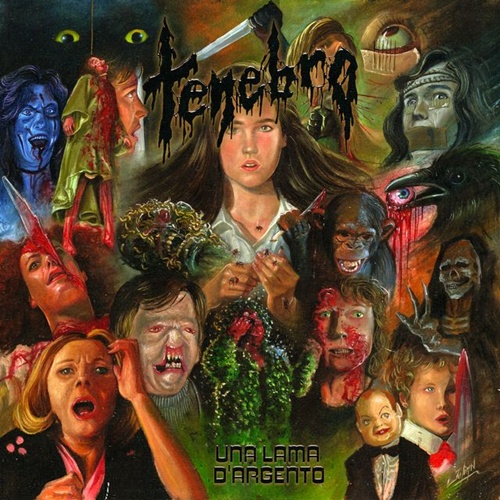
La copertina di “Una Lama D’Argento” è stata realizzata da Julian Ibanez. Quanto è stato stretto il rapporto con l’artista e quali indicazioni precise sono state fornite per assicurare che l’opera grafica incarnasse visivamente il titolo tagliente dell’album e l’orrore claustrofobico di stampo argentiano?
Con Julian c’è stato subito un allineamento. Gli abbiamo mandato immagini, reference, sensazioni: volevamo qualcosa che fosse elegante ma spaventoso, come le scenografie di Argento. Volevamo una copertina che non fosse solo un “bel disegno”, ma un ingresso nell’album. Lui ha trovato l’equilibrio perfetto: una cover che sembra un manifesto di un film horror italiano mai realizzato. È esattamente ciò che volevamo.
Nati come studio project, avete debuttato live nel 2023, definendo la performance come un’esperienza teatrale “intrisa di sangue, disgusto, decomposizione e brutalità ineguagliabile”. Quanto è impegnativo e come viene strutturato un live show per garantire l’equilibrio tra l’elemento teatrale e la potenza sonora?
Il live è la parte più faticosa ma più vera del nostro mondo. Non vogliamo fare la solita esibizione death metal: vogliamo che il pubblico entri in un rito. Sangue, macchina del fumo che non si ferma mai, movimenti controllati, momenti di silenzio, esplosioni improvvise… tutto è pensato come se stessimo dirigendo una scena di un giallo. La difficoltà è mantenere la precisione del death metal mentre fai teatro. Devi essere lucido ma anche completamente immerso. È un equilibrio complicato, ma quando funziona il pubblico lo percepisce: non sta assistendo a un concerto, ma a un’esperienza disturbante.
Dopo il debutto live e l’imminente uscita di “Una Lama D’Argento”, ci sono già date o un tour in programma per portare in giro il vostro rituale di giallo metal? I fan dove potranno aspettarsi di vedere i Tenebro nel prossimo futuro?
Con l’uscita di “Una Lama D’Argento” abbiamo già delle date in programma alcune annunciate, altre in arrivo. La volontà è portare questo rituale in giro il più possibile: festival, club piccoli, situazioni estreme dove il nostro immaginario può respirare (o soffocare) meglio. La gente potrà aspettarsi annunci a breve: siamo pronti a trasformare ogni palco in un incubo italiano.
Con una discografia così prolifica in pochi anni, qual è il piano immediato per i Tenebro dopo l’uscita di “Una Lama D’Argento”? Avete in programma di continuare questa narrazione giallo metal dedicata ad Argento, o l’attenzione tematica del prossimo materiale si sposterà su un altro maestro dell’horror italiano (come Fulci o Bava)?
Questo disco chiude un ciclo, ma non chiude la nostra relazione con il cinema italiano ovviamente. Argento è stato un tempio per noi, e questo album è la nostra processione più devota. Ma abbiamo anche altre ossessioni: Fulci, Bava, Soavi, Martino, Mattei… tutti mondi diversi, tutti con un proprio linguaggio visivo. Non so ancora se il prossimo capitolo sarà un altro tributo monografico o un incubo più astratto. Ma so che rimarremo fedeli al nostro metodo: prendere un immaginario e trasformarlo in brutalità emotiva. Il giallo metal forse lo hanno inventato gli altri, ma gli incubi li facciamo noi.
With “Una Lama D’Argento” (Time to Kill Records), Tenebro take their most extreme and visionary step yet: an entire album dedicated to Dario Argento, the undisputed master of horror and giallo cinema. Eleven tracks that are not just songs, but episodes of a single nightmare, where iconic scenes from his films are transformed into sharp riffs, guttural vocals, relentless drumming, and atmospheres shifting between pure violence and suffocating tension. In “Una Lama D’Argento”, Tenebro do not merely evoke Argento’s universe: they embody it, rewriting his obsessions in style giallo metal.
Welcome, Hannes! Your new album, “Una Lama D’Argento”, is a visceral tribute to Dario Argento’s cinema, described as your most extreme and visionary step. What led you to decide to dedicate an entire album—an in-depth work with eleven episodes of a single nightmare—to the master of Giallo, and how did his aesthetic of terror translate into such a brutal sonic attack?
“Una Lama D’Argento” was born from an obsession we’ve had for years. For us, Argento is not just a master of horror: he’s a mental architecture. His lighting, his camera movements, the logic of his murders… these are patterns we’ve always felt close to our idea of extreme music. At some point, we looked at each other and realized we wanted to take a step no one had truly taken before: dedicating an entire album to Dario Argento, but not as fan service—like a monographic nightmare. Eleven tracks that are not eleven “songs,” but eleven chapters of a single long night. To translate Argento into music, we worked as if we were filming the album, not recording it. The riffs follow editing cuts, the percussion replicates the heartbeat of a tense scene, and certain melodies arrive like those strangely poetic flashes that interrupt the slaughter in his films. We tried to capture his way of striking: sudden, elegant, merciless. It’s our sharpest, most visual, most obsessive record.
Your music has been defined as “Giallo Metal,” a rewriting of the Argento universe. What exactly defines this subgenre beyond lyrical references? And why is the choice to write music, lyrics, and intros entirely in Italian so crucial to the band’s identity and to fully embody this style?
We didn’t invent the definition Giallo Metal. It came from the press, from reviews after “L’Inizio Di Un Incubo.” Some blogs and webzines started calling us that, and it stuck naturally, spontaneously. And the crazy thing is, it fits. It’s a subgenre of a subgenre, something that exists because our imagination is so tied to Italian cinema that it deserves its own category. And for us, it’s fantastic that this definition is 100% Italian, because our sound, our lyrics, our entire idea of “musical horror” comes from there. Italian is indispensable: it’s not a stylistic choice, it’s an emotional constraint. Words carry a different weight, a different color.
The single “Impiccata” is a fast, uncompromising track that recalls the relentless intensity of an iconic scene from Suspiria. Why did you choose “Impiccata” as the first single to represent the “sharp, immediate, and merciless” sound of this album, and how does the sudden violence of Giallo fit into the brutality of death metal?
“Impiccata” was our calling card because it embodies what “Una Lama D’Argento” is: speed, brutal improvisation, zero breathing space. It hits you like an Argento scene: you don’t see it coming, and when it arrives, it’s too late. The Suspiria scene we drew inspiration from is one of the most violent and sudden in all of Argento’s cinema. For us, it was perfect as the first single: direct, sharp, claustrophobic. We wanted listeners to immediately understand that this record is a knife thrown across the room: it comes at you without explanation.
How do you approach composing a track starting from a specific image or cinematic sequence, trying to transform visual terror into rhythmic structure, while introducing new symphonies and melodies without betraying the extreme core of the band?
I work a lot with images. Even before touching the instruments, I visualize something: a detail, a moving camera, a murder, a lens stained with blood, a corridor that’s too long. I don’t want to describe the scene; I want to turn it into a physical sensation. Then Il Becchino comes in with his melodic and theatrical vision: harmonizations, vocal lines, that “narrative” touch he naturally has. That way, the image becomes music, and the music becomes a coherent nightmare.
You are a duo, consisting of “Il Becchino” on guitar and vocals and “Il Beccamorto” on bass, drums, and guitar. How does this essential lineup influence the writing, arranging, and production process, and how do you manage to maintain variety and sonic evolution while working with such a reduced formation?
Being a duo is a perfect curse. You can’t hide behind anyone: you have to do everything, and you have to do it well. I handle the rhythmic foundation, the skeleton: drums, bass, some guitars. Il Becchino brings his narrative spirit, his theatricality, his wildest riffs, and his voice. It’s a continuous bounce between the two of us: zero dispersion, zero diplomacy, zero compromise. When there are few of you, you have to be creative: you need two people to sound like five, without over-inflating the production. This forces us to invent solutions, change structures, get our hands dirty.
The cover of “Una Lama D’Argento” was created by Julian Ibanez. How close was the collaboration with the artist, and what specific directions were given to ensure the artwork visually embodied the sharp title of the album and the claustrophobic horror typical of Argento?
With Julian, there was immediate alignment. We sent him images, references, sensations: we wanted something elegant yet frightening, like Argento’s set designs. We wanted a cover that wasn’t just a “pretty drawing,” but an entrance into the album. He found the perfect balance: a cover that looks like a poster for a never-made Italian horror film. It’s exactly what we wanted.
Born as a studio project, you debuted live in 2023, defining the performance as a theatrical experience “steeped in blood, disgust, decomposition, and unmatched brutality.” How demanding is it, and how is a live show structured to ensure the balance between theatrical elements and sonic power?
Live is the most exhausting but truest part of our world. We don’t want to do the usual death metal performance: we want the audience to enter a ritual. Blood, smoke machines that never stop, controlled movements, moments of silence, sudden explosions… everything is designed as if we were directing a Giallo scene. The challenge is maintaining the precision of death metal while performing theater. You need to be lucid but also completely immersed. It’s a complicated balance, but when it works, the audience feels it: they’re not attending a concert, but a disturbing experience.
After your live debut and the upcoming release of “Una Lama D’Argento,” are there already dates or a tour planned to bring this Giallo Metal ritual on the road? Where can fans expect to see Tenebro in the near future?
With the release of “Una Lama D’Argento,” we already have some dates planned, some announced, others coming soon. The intention is to take this ritual as far as possible: festivals, small clubs, extreme situations where our imagination can breathe (or suffocate) best. People can expect announcements soon: we’re ready to turn every stage into an Italian nightmare.
With such a prolific discography in a few years, what is Tenebro’s immediate plan after the release of “Una Lama D’Argento”? Do you plan to continue this Giallo Metal narrative dedicated to Argento, or will the thematic focus of the next material shift to another master of Italian horror (like Fulci or Bava)?
This record closes a cycle, but it doesn’t close our relationship with Italian cinema, obviously. Argento was a temple for us, and this album is our most devoted procession. But we have other obsessions too: Fulci, Bava, Soavi, Martino, Mattei… all different worlds, each with its own visual language. I don’t yet know if the next chapter will be another monographic tribute or a more abstract nightmare. But I know we will remain faithful to our method: take an imaginary world and transform it into emotional brutality. Giallo Metal may have been invented by others, but the nightmares are ours.
 Il Raglio del Mulo