
ENGLISH VERSION BELOW: PLEASE, SCROLL DOWN!
Niente hype, niente compromessi con le mode, solo la lenta combustione di una band che non si è mai piegata. I Melechesh riemergono dalla polvere dei secoli con “Sentinels Of Shamash”, forgiato sotto Reigning Phoenix Music e canalizzato dalla visione di Ashmedi. Quello che segue non è un ritorno, ma la prosecuzione di un cammino inciso nella pietra, dove correnti antiche e acciaio annerito continuano a parlare con voce propria.
Prima di tutto, benvenuto su Il Raglio Del Mulo; il vostro ritorno con “Sentinels Of Shamash” via Reigning Phoenix Music mette fine a un lunghissimo silenzio discografico, quindi che sensazione provi a svelare finalmente questi nuovi brani e in che modo rappresentano l’evoluzione del Mesopotamian Metal nel 2026?
È una sensazione grandiosa, quasi surreale. Sono successe molte cose nel mondo e nella mia vita dai tempi di “Enki”. Il tempo ha un modo tutto suo di affinare la visione. Il silenzio a livello di uscite in studio non significa inattività. In quel periodo i Melechesh hanno fatto tour in maniera massiccia, oltre dieci tour europei, oltre a concerti in altre parti del mondo e innumerevoli festival. Ho anche partecipato a varie collaborazioni, apparizioni come ospite e persino ghostwriting dietro le quinte. Quindi a livello creativo e professionale c’è sempre stato movimento. Allo stesso tempo stavo scrivendo, osservando, evolvendo e vivendo nel caos, sia personale che globale. Tutto questo inevitabilmente finisce nella musica. Con “Sentinels Of Shamash” credo che abbiamo preservato l’essenza dei Melechesh affilando ulteriormente la lama. Il DNA è intatto, lo spirito sumero mesopotamico, l’aggressione blackened thrash, i temi mistici e accademici, e le tonalità mediterranee e mediorientali. Ma questa uscita è più focalizzata, più cinematografica e in un certo senso più audace. La scrittura è più compatta, ma ci sono strati che si rivelano col tempo. Il “Mesopotamian Metal” nel 2026 non significa ripetere il passato. Significa evolversi senza perdere identità. Siamo stati tra i primi a tracciare questo percorso e con questo EP riaffermiamo quella forza unica aprendo al tempo stesso nuovi portali.
Considerando che i fan aspettavano nuovo materiale da oltre un decennio, cosa vi ha portato a pubblicare un EP invece di un album completo dopo una pausa così lunga, e vedi questi tre brani come un rituale a sé stante o come l’anticamera di qualcosa di più grande?
Diversi fattori hanno portato a questa decisione. Prima di tutto non volevo pubblicare materiale solo per interrompere l’attesa. Preferisco la qualità alla quantità e questi tre brani erano abbastanza forti da reggersi in piedi da soli senza essere diluiti da riempitivi. Tra i numerosi tour negli anni e alcuni ritardi in varie fasi di studio e produzione, questa è diventata la soluzione più logica. Invece di far aspettare ancora di più le persone, abbiamo scelto di offrire tre pezzi potenti, ognuno con un approccio diverso ma tutti all’interno della sfera sonora dei Melechesh. Ogni brano ha un’energia e un carattere distinti, pur restando chiaramente riconoscibile. Oggi l’attenzione è più breve e l’industria è cambiata drasticamente, quindi un EP può essere un modo efficace per colpire e mantenere il movimento. Allo stesso tempo questo EP funge da ponte, una dichiarazione che i Melechesh sono vivi e in evoluzione. È sia un rituale autonomo sia un preludio a qualcosa di più grande. I tre brani sono legati per spirito ed energia, quasi come tre capitoli di un unico manoscritto, ma aprono anche portali verso il prossimo full length. Ci sono state anche ragioni pratiche. Volevamo iniziare questo nuovo capitolo con Reigning Phoenix Music nel modo giusto, reintrodurre i Melechesh con nuovi brani anche a una nuova generazione e costruire l’attesa passo dopo passo. Invece di sparire ancora più a lungo per lavorare a un album completo, abbiamo deciso di colpire ora con qualcosa di potente, diretto e significativo. E state tranquilli, un full length è già in lavorazione.
L’architettura sonora di questo lavoro sembra unire mitologia sumera e metal estremo in modo ancora più fluido rispetto al passato, quindi qual è stata la scintilla creativa principale che ti ha portato a sviluppare “The Seventh Verdict” e “In Shadows, In Light” come capitoli iniziali di questo percorso?
La scintilla creativa può arrivare da molte dimensioni. A volte parte da un riff, altre da un ritmo, da un concetto o anche solo da una frase o un’immagine nella mente. Non seguo formule, lascio che sia l’energia a guidarmi. Con “The Seventh Verdict” mi sono ispirato ai temi dell’Epopea Di Gilgamesh, questioni di moralità, potere e l’idea che la storia venga spesso scritta dal vincitore. Mi piace esplorare le zone grigie, chi è davvero l’eroe e chi il cosiddetto villain. C’è anche una corrente di punizione divina e giudizio cosmico che attraversa il brano. Musicalmente parte in modo feroce e aggressivo e si trasforma in qualcosa di più caotico e vorticoso verso la fine. “In Shadows, In Light” arriva invece da un’altra dimensione. Esplora la dualità, dimensioni nascoste e forze invisibili, ciò che alcuni chiamano magick, ma che io considero scienza non ancora scoperta. Ci sono riferimenti alla Kabbalah, alla conoscenza antica e forse anche all’idea che ciò che chiamiamo mito fosse in realtà una realtà fraintesa. Musicalmente intreccia elementi psichedelici all’aggressione, creando un’atmosfera quasi ipnotica. Entrambi i brani sono porte diverse ma collegati dalla stessa corrente, la ricerca di conoscenza oltre l’ovvio incanalata nel dominio sonoro dei Melechesh.
Dal momento che la produzione è stata condivisa tra te, Rob Caggiano e Kristian Kohlmannslehner, in che modo questo lavoro collettivo in studio ha aiutato a bilanciare gli elementi mediorientali tradizionali con le fondamenta thrash e black metal del vostro suono?
Ho sempre avuto una visione molto chiara per i Melechesh, quindi identità e direzione erano definite fin dall’inizio. Scrivo la maggior parte della musica e degli arrangiamenti e so esattamente quale atmosfera ed energia voglio canalizzare. Il termine produttore può avere significati diversi. Ci sono produttori in senso artistico, che aiutano a plasmare la visione e guidare il progetto, e altri più tecnici, focalizzati su suono, registrazione e resa finale. Dal punto di vista artistico ero io a guidare la nave. I Melechesh hanno un’identità molto definita. Rob Caggiano ha portato orecchie fresche, istinto musicale e gusto. Oltre a suonare il basso, ha contribuito agli arrangiamenti di “In Shadows, In Light” e alla produzione vocale. Ha una grande comprensione di dinamiche e groove e ha migliorato diversi dettagli senza snaturare l’essenza. Kristian Kohlmannslehner e il team dei Kohlekeller Studio sono stati fondamentali sul lato tecnico. Ha capito subito la mia visione, volevo un suono di chitarra organico e quasi retrò ma allo stesso tempo moderno e thrash. Due concetti opposti ma che volevo insieme. Lui ha accettato la sfida e il risultato è stato esattamente quello che avevo in mente. La sala batteria ha un ambiente naturale incredibile che ha dato enorme profondità alle registrazioni. Alla fine è stata una questione di sinergia. Gli elementi mediorientali erano già nel DNA dei brani, la collaborazione li ha resi ancora più incisivi in un contesto blackened thrash. Il risultato è affilato, dinamico e autentico.
L’inclusione di “Magic Spells” nei crediti ufficiali insieme a chitarre a 12 corde e percussioni suggerisce che le sessioni non siano state solo un processo tecnico, quindi puoi raccontare come questi elementi occulti e rituali si sono manifestati durante le registrazioni?
Haha, alcune cose è meglio lasciarle nel mistero. Il credito “Magick Spells” è ironico ma non del tutto. Quando parlo di magick intendo spesso scienza non ancora compresa, energie e vibrazioni. In questo caso si riferisce alle incantazioni nei testi, alla vibrazione delle parole e a quello che chiamo la spezia, quell’elemento intangibile che dà forza alla musica. Non è misurabile ma si percepisce. Può essere nella voce, nel fraseggio o nell’atmosfera. La creatività non è sempre un processo razionale. A volte sembra arrivare da altrove, intuizione o subconscio. Non stavamo sacrificando capre in studio, almeno non ogni giorno, ma c’era una volontà precisa di creare un certo stato. Ripetizione, trance, immersione. A un certo punto smetti di suonare e inizi a canalizzare. Questo si sente soprattutto in “In Shadows, In Light”, dove la musica si muove tra dimensioni diverse, tra aggressione e psichedelia, tra ombra e luce. Quindi sì, può sembrare uno scherzo, ma dietro c’è qualcosa di reale.
Passando all’estetica visiva, Nestor Avalos ha realizzato una copertina molto dettagliata che riflette l’approccio mitologico dei brani, com’è stato il dialogo con lui per rappresentare correttamente il simbolismo dei “Sentinels”?
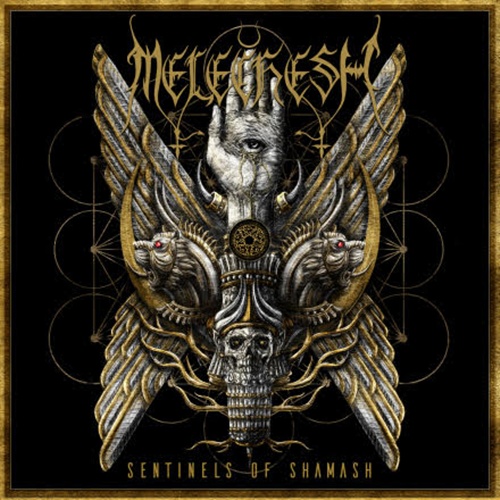
Nestor Avalos è un artista straordinario e collaboriamo da tempo. Aveva già realizzato grafiche per i Melechesh anni fa e ci siamo incontrati durante un tour in Messico. Quando è arrivato il momento di questo lavoro gli ho proposto di occuparsi della copertina e ha accettato dando tutto sé stesso. Io parto sempre da un concept preciso, fornisco simboli, atmosfera e riferimenti visivi. Con “Sentinels Of Shamash” volevo richiamare la grandezza mesopotamica, il mistero e il giudizio divino legato a Shamash. I Sentinels rappresentano guardiani, osservatori, forse esecutori di una legge cosmica. C’è ambiguità tra benevolenza e severità. Abbiamo lavorato insieme sui dettagli finché tutto non ha trovato equilibrio. Lui ha elevato molte idee oltre quello che immaginavo. Colori, scala e atmosfera si fondono perfettamente con la musica. Per me l’artwork non è decorazione ma parte del rituale.
Nel corso dei decenni i Melechesh sono passati dal Medio Oriente a una dimensione globale, c’è un momento della vostra storia che definisce ancora oggi la vostra identità di forza unica?
Ci sono stati molti momenti. I Melechesh sono nati a Gerusalemme nel 1993 in un contesto già fuori dal comune. Fare questo tipo di musica lì era un atto di ribellione. Col tempo la band è diventata qualcosa di più, un’entità. Alcuni dicono che rifletta la mia vita, forse è vero. Io mi vedo come un custode. Ho sempre vissuto in modo internazionale, parlando diverse lingue e vivendo in vari paesi. Vedo il mondo come un unico quartiere. Le frontiere contano poco. Questa visione si riflette nei Melechesh. Veniamo da una regione culla di civiltà, dove culture e miti si intrecciano. Quello che facciamo è anche universale. Ricordo i primi tour internazionali, persone di culture diverse connesse profondamente alla musica. Quella è stata la prova che stavamo andando oltre ogni barriera. Nonostante cambi di line up, crisi e difficoltà, i Melechesh sono rimasti in piedi. Non abbiamo mai inseguito trend, abbiamo creato il nostro percorso. Questa è la nostra forza.
In vista dei concerti tra Germania e Francia, come trasporterete la complessità dei nuovi brani in un contesto live più diretto?
Purtroppo non siamo riusciti a suonare ad aprile. Ero a Gerusalemme durante una guerra e ho deciso di restare. Spazio aereo chiuso e situazione pericolosa. Mia madre è anziana e non potevo lasciarla. La famiglia viene prima. La guerra è follia, pura tragedia. A maggio suoneremo in Francia e sarà una buona occasione per testare i nuovi brani. Il live è fondamentale, è energia pura. Non si tratta di replicare il disco ma di catturare essenza e intensità. I Melechesh sono sempre stati forti dal vivo e sappiamo tradurre le stratificazioni in qualcosa di diretto. Le tonalità mediterranee sono già nei riff, quindi emergono naturalmente. Puntiamo su groove, aggressione e atmosfera. Brani come “The Seventh Verdict” e “In Shadows, In Light” funzionano bene per i contrasti tra violenza e trance. Il pubblico europeo è sempre stato incredibile. Un concerto dei Melechesh è un’esperienza.
Guardando oltre “Sentinels Of Shamash”, quali territori musicali e filosofici state esplorando per il futuro della band?
Non mi piace ripetermi. Quando l’arte diventa prevedibile perde forza. I Melechesh evolvono mantenendo il proprio DNA. Abbiamo una nostra dimensione che ci permette libertà. La sfida è spingere oltre senza perdere identità. A livello filosofico continuo a esplorare misteri antichi, coscienza e connessioni tra mito e scienza. Musicalmente voglio ampliare ancora le dinamiche, momenti più atmosferici e altri più feroci, mantenendo la base blackened thrash. Ci sono già molti brani pronti per il prossimo album. Idee non mancano, abbiamo centinaia di riff. Poi arriva il momento di organizzare tutto e dare forma al lavoro. Può essere impegnativo, ma è parte del processo. Alla fine conta sempre la canzone. Niente sperimentazione fine a sé stessa. Tutto deve servire allo spirito della band. I Melechesh continueranno a sorprendere, ma sempre all’interno del proprio dominio.
No hype, no trend-chasing, only the slow burn of a band that never bent the knee. Melechesh emerge once more from the dust of ages with “Sentinels Of Shamash”, forged under Reigning Phoenix Music and channeled through the vision of Ashmedi. What follows is not a comeback narrative, but a continuation of a path carved in defiance, where ancient currents and blackened steel still speak with their own voice.
First of all, welcome back to Il Raglio Del Mulo; your return with “Sentinels Of Shamash” via Reigning Phoenix Music ends a very long silence since your last studio work, so how does it feel to finally unveil these new compositions and how do they represent the evolution of Mesopotamian Metal in 2026?
It feels great, almost surreal. A lot has happened in the world and in my own life since “Enki”. Time has a way of refining vision. Silence in terms of studio releases does not mean inactivity. During that period, Melechesh toured extensively—over ten European tours, as well as performances in other parts of the world and countless festivals. I’ve also done various guest appearances, collaborations, and even some ghostwriting behind the scenes. So creatively and professionally, there was always movement. At the same time, I was writing, observing, evolving, and living through chaos—both personal and global. All of that inevitably seeps into the music. With “Sentinels Of Shamash”, I believe we have preserved the essence of Melechesh while sharpening the blade. The DNA is intact: the Sumerian/Mesopotamian spirit, the blackened thrash aggression, the mystical and scholarly themes, and the Mediterranean and Middle Eastern tonalities. But this release feels more focused, more cinematic, and in some ways more daring. The songwriting is tighter, yet there are layers that reveal themselves over time. “Mesopotamian Metal” in 2026 is not about repeating the past. It is about evolving without losing identity. We were among the first to carve this path, and with this EP we reaffirm that singular force while opening portals to new dimensions.
Considering that fans have been waiting for over a decade for new material, what led to the decision to release an EP instead of a full-length album after such a significant hiatus, and do you see these three tracks as a self-contained ritual or a precursor to something larger?
A few factors led to that decision. First, I did not want to release material just for the sake of ending the wait. I prefer quality over quantity, and these three songs felt strong enough to stand on their own rather than be diluted by filler. Between extensive touring over the years and some delays that happened in various studios and production phases, this became the most logical solution. Instead of making people wait even longer, we chose to give them three powerful songs—each with a diverse approach, yet all existing within the Melechesh domain or sphere of sound. Each track carries a different energy and character, while still being unmistakably Melechesh. In today’s world, attention spans are shorter and the industry has changed drastically, so releasing an EP can be a powerful way to make an impact while keeping momentum. At the same time, this EP serves as a bridge—a statement that Melechesh is very much alive and evolving. It is both a self-contained ritual and a precursor to something larger. The three tracks are connected in spirit and energy, almost like three chapters of one manuscript, but they also open portals toward the next full-length. There were also practical reasons. We wanted to begin this new chapter properly with Reigning Phoenix Music, reintroduce Melechesh with new songs—not only the ones older fans were already familiar with—to a new generation, and build anticipation step by step. So rather than disappear for even longer while crafting a full album, we chose to strike now with something powerful, concise, and meaningful. And rest assured—a full-length is already being forged.
The sonic architecture of this record seems to bridge Sumerian mythology with an extreme metal framework even more seamlessly than before, so what was the primary creative spark during the songwriting process that led you to explore “The Seventh Verdict” and “In Shadows, In Light” as the opening chapters of this journey?
The creative spark can come from many dimensions. Sometimes it begins with a riff, sometimes with a rhythm, a concept, or even a phrase or image in my mind. I don’t follow a formula. I let the energy guide me. With “The Seventh Verdict”, I was inspired by themes surrounding the Epic Of Gilgamesh—questions of morality, power, and the idea that history is often written by the victor. I like exploring the gray areas: who is truly the hero, and who is the so-called villain? There is also an undercurrent of divine retribution, of cosmic judgment, which ties into the spirit of the song. Musically, it starts in a fierce, aggressive way and evolves into something more chaotic and vortex-like toward the end. “In Shadows, In Light” came from another realm entirely. It explores duality, hidden dimensions, unseen forces—what some may call magick, but I often say magick is simply undiscovered science. There are references to Kabbalistic ideas, ancient knowledge, and perhaps even the possibility that what we call myth was once misunderstood reality. Musically, it has subtle psychedelic elements woven into the aggression, creating an almost hypnotic atmosphere. Both songs are different gateways, but they are connected by the same current: seeking knowledge beyond the obvious and channeling it through the Melechesh sonic domain.
Since the production duties were shared between Ashmedi, Rob Caggiano, and Kristian Kohlmannslehner, how did this collaborative effort in the studio help in balancing the traditional Middle Eastern musical elements with the aggressive thrash and black metal foundations of your sound?
I have always had a very clear vision for Melechesh, so the core identity and direction were firmly established from the start. I write the vast majority of the music and arrangements, and I know exactly what atmosphere and energy I want to channel. That said, the word “producer” can mean different things. There are producers in the artistic sense—people who help shape the vision, inspire performances, challenge ideas, and guide the overall direction of a project. Then there are producers or engineers in the more technical sense—people focused on sonics, recording techniques, tones, microphone placement, and getting the best guitar, drum, and overall sound. In the artistic and conceptual sense, I was very much steering the ship. Melechesh has a very defined identity and sonic domain. Rob Caggiano brought a fresh set of ears, strong musical instinct, and great taste. He is not only a producer but also a composer and musician himself, so we clicked naturally and had a lot of chemistry when it came to being “in the zone.” Beyond playing bass on the EP, he contributed to arrangements on “In Shadows, In Light”, and was very involved in vocal production. Rob has a deep understanding of dynamics and groove, and he helped enhance certain details without compromising the essence of Melechesh. Kristian Kohlmannslehner and his team at Kohlekeller Studio were fantastic on the technical and sonic side. Kristian really understood my vision. I explained to him that I wanted the guitar sound to feel organic and somewhat retro, yet at the same time modern and thrashy. In a way, those are almost opposing qualities, but I wanted both feelings at once. His answer was, “I love this—I love a challenge.” Between my guitars and pickups, his sonic knowledge, customized amplifiers, and microphone placement techniques, he absolutely nailed it. The result was exactly what I had envisioned. The drum room there, in particular, has an incredible natural ambiance that gave the recordings a huge and alive feeling. He also respected the more exotic tonalities and textures that define our sound. So in the end, it was about synergy. The Middle Eastern and Mediterranean elements were already embedded in the DNA of the compositions; the collaboration helped present them in the most powerful way possible within an aggressive blackened thrash metal framework. The result is sharp, dynamic, and authentic.
The inclusion of “Magic Spells” in the official credits alongside 12-string guitars and percussion suggests that the recording sessions were more than just a technical process, so could you share how these occult themes and ritualistic atmosphere actually manifested during the tracking of the instruments?
Haha, well… some mysteries are better left unsolved. The “Magick Spells” credit is a little tongue-in-cheek, but as with many things in Melechesh, there is truth hidden behind humor. When I say “magick,” I often mean undiscovered science, new knowledge, or energies and vibrations not yet fully understood. Ancient civilizations may have perceived certain things differently, and what was once called magic may one day simply be explained by science. In this particular case, the “Magick Spells” mostly refer to the lyrical incantations, the vibrations of words, and what I call “the spice”—that intangible ingredient that gives music its unseen force. It’s not something you can measure technically, but you can feel it. Sometimes it’s in the delivery of a vocal line, the phrasing of a riff, or the atmosphere created by certain harmonies and rhythms. For me, creativity is not always a purely intellectual process. Sometimes ideas seem to come from somewhere beyond the conscious mind—call it intuition, the subconscious, cosmic energy, or simply being in a heightened creative state. So while we were not literally sacrificing goats in the studio… at least not every day… there was definitely an intentional effort to create a certain vibe. Repetition, trance-like riffing, mood, and immersion can put you into a zone where the performance becomes more than technical execution. You stop “playing” and start channeling. That atmosphere especially manifests in tracks like “In Shadows, In Light”, where the music itself moves between dimensions—between aggression and psychedelia, between shadow and illumination. So yes, “Magick Spells” may seem like a joke in the credits… but behind it lies an idea that is very real.
Moving from the studio to the visual aesthetic, Nestor Avalos has created a very intricate cover art that seems to mirror the scholarly mythological focus of the tracks, but what was the specific dialogue like between the band and the artist to ensure the symbolism of the “Sentinels” was accurately represented?
Nestor Avalos is a fantastic and very talented artist, and we actually go back quite a while. He first did some T-shirt designs for Melechesh over eleven years ago. Then, a few years back when we toured Mexico, he also created a tour shirt and poster design for us, and we finally met in person there. He’s a true gentleman, and we stayed in touch over the years. So when the time came for this release, I thought, why not give it a shot and see if he’d be interested in creating the artwork? Thankfully, he was—and he really gave it his all. He worked around the clock and absolutely nailed it. I usually come into these things with a very clear concept. I don’t just say, “Make something cool.” I provide themes, symbolism, atmosphere, and often very specific visual references or sketches. With “Sentinels Of Shamash”, I wanted imagery that reflected ancient Mesopotamian grandeur, mystery, cosmic energy, and divine judgment. Shamash, being the Mesopotamian sun god associated with justice and truth, was a central pillar of the concept. The “Sentinels” themselves symbolize guardians—watchers, protectors, and perhaps enforcers of cosmic law or hidden knowledge. There is also ambiguity there: are they benevolent or severe? I like that duality. Nestor and I exchanged ideas back and forth, refining details until the balance felt right. He brought his own artistic interpretation and elevated some aspects beyond what I initially imagined, which is always great when working with talented people. The colors, the monumental scale, and the mythological atmosphere all came together in a way that complements the music perfectly. For me, artwork is not decoration; it is part of the ritual. It is often the first portal into the world of the music. In this case, Nestor captured that world brilliantly.
Over the decades, Melechesh has moved from the Middle East to becoming a global phenomenon, and looking back at your history of overcoming cultural barriers, is there a particular moment or anecdote from your long career that you feel still defines your “singular force” identity today?
There have been many moments, to be honest. Melechesh was born in Jerusalem in 1993 under circumstances that were already unusual. Creating this kind of music there at that time was, in itself, an act of rebellion and vision. Over the years, Melechesh has grown beyond being “just a band.” It has become an entity, a domain, almost a society. Some people say it is a direct reflection of my life story, or that it runs parallel to it. Perhaps there is truth in that. But I see myself more as a custodian, or even a monk, serving the entity itself rather than serving my ego. I channel it, nurture it, and protect its essence. My own life has always been very international and cosmopolitan. Even in Jerusalem, I was considered somewhat of an expat because my family came from abroad. I was educated in international schools, raised among friends from all over the world, speak around six languages, and have lived in many countries—from Africa to Europe, North America, the Near East, and around the Mediterranean. So I tend to see the whole planet as one big neighborhood. Borders mean very little to me. I see countries as neighborhoods of the world, each with its own twist, culture, spice, and approach to life. That diversity is fascinating, and I think that worldview is reflected in what Melechesh represents. We come from a region often called the cradle of civilization—a place where ideas, mythologies, spiritual systems, and cultures kept expanding and evolving into one another. It is all interconnected. So while people may call what we do “Mesopotamian Metal,” “Middle Eastern Metal,” “Near Eastern Metal,” or even “Mediterranean Metal,” in truth it is also cosmic and universal. It is inclusive, not exclusive. I remember when we first started touring internationally and I saw people from completely different cultures connecting deeply with the music and the themes. That was powerful. It proved that what we were channeling transcended geography and language. And despite lineup changes, industry shifts, political tensions, wars, and personal challenges, Melechesh remained standing and evolving. That resilience is part of the identity. We never chased trends—we created our own lane. That is where the singular force comes from.
As you prepare to hit the road this April and May with dates in Germany and France, how are you translating the complex arrangements and the Mediterranean textures of the new material into a raw, live experience for the fans in Nordrhein-Westfalen and Chauvigny?
Unfortunately, we couldn’t make it to the April show. I was in Jerusalem during a full-blown war, and I made the decision to stay. There was also a full closure of the airspace, with missiles flying everywhere. My mother is getting older, and I simply could not leave her under such circumstances. Family comes first, and sometimes life overrides even the best-laid plans. Everybody knows my opinion on war in general—it is madness. It is garbage, and above all, a tragedy. But in May we’ll be heading to headline a festival in France, and we’re very much looking forward to it. In a way, it will serve as a warm-up and a chance to test some of the new songs live in front of an audience. Playing live is extremely important to me. I live for that energy. Sometimes I joke and say it’s the best excuse to play loud and no one complains—haha. But there is truth in it; there is something primal and liberating about being on stage and channeling that energy with the audience. Live, the goal is not to replicate the studio versions note for note. The goal is to capture the essence, the energy, and the ritualistic intensity of the songs in a more raw and immediate way. Melechesh has always been a strong live band, and over the years we’ve learned how to translate layers and textures into something powerful on stage without losing impact. Some of the Mediterranean and Middle Eastern tonalities are embedded in the riffs and melodies themselves, so they naturally come through even without all the studio layering. With the new material, we focus on the strongest elements—the groove, the aggression, the atmosphere, and the dynamics. Songs like “The Seventh Verdict” and “In Shadows, In Light” have very distinct energies, and we emphasize those contrasts live. One moment can feel like a violent sonic assault; the next can feel hypnotic and trance-like. And of course, audiences in France and Germany have always been very supportive and passionate. We feed off each other. In the end, a Melechesh show is not just a concert—it is an experience, almost like stepping into another realm for an hour.
Looking toward the horizon beyond the release of “Sentinels Of Shamash” on April 10, 2026, what new philosophical or musical territories are you beginning to eye for the future of Melechesh to ensure the project remains an unpredictable pillar of extreme metal?
I never like to repeat myself, and I never create with the intention of following expectations. The moment art becomes predictable, it loses part of its magick. Melechesh has always evolved while keeping its core identity intact. We have our own domain—our own concept, if you will—which gives us a lot of liberty to move around both sonically and thematically without losing who we are. The challenge is to push boundaries while preserving the essence—the DNA that makes it unmistakably Melechesh. Philosophically, I’m always exploring new dimensions of thought: ancient mysteries, hidden knowledge, cosmic consciousness, the interconnectedness of civilizations, and the unseen threads between mythology, science, and spirituality. There is still an infinite amount of territory to explore there. Musically, I’m interested in expanding the dynamics even further—perhaps going deeper into atmosphere in some moments, becoming more savage and primal in others, while still maintaining the aggressive blackened thrash foundation. I always enjoy weaving in Mediterranean, Near Eastern, and psychedelic textures in subtle or unexpected ways. We already have several songs written for the next album. Of course, I like to revisit them, refine them, and leave space for new ideas to emerge. Believe me, there is no shortage of ideas—we have hundreds of riffs. I prefer to keep moving forward creatively rather than limiting myself too early. Then comes the time when I have to revisit everything, organize it, and shape it into a coherent body of work… and yes, sometimes that can feel a bit overwhelming. Haha. At the same time, I value strong songwriting above all. No experimentation for the sake of experimentation. Everything has to serve the song and the spirit of the entity. So yes, ideas are already being forged for the next full-length, and perhaps other special projects as well. Melechesh will continue to surprise people—but always within its own domain.

