
ENGLISH VERSION BELOW: PLEASE, SCROLL DOWN!
Abbiamo scambiato quattro chiacchiere con Simone degli Sconfitta, collettivo musicale autore dell’album “Essere Nessuno”, uscito il primo maggio 2026. Il disco è accompagnato dal “Libricino Per Nessuno”, un complemento scritto che amplia e approfondisce i temi affrontati nei brani. Tra hardcore punk, metal, post punk, dark wave, jazz e influenze inattese, il progetto si muove fuori dagli schemi tradizionali della band, proponendo una visione collettiva e fortemente concettuale della musica. In questa intervista abbiamo parlato della nascita del progetto, delle scelte stilistiche e del significato dietro un lavoro che rivendica con orgoglio la libertà di fallire.
Ciao Simone, grazie per essere qui con noi su Il Raglio Del Mulo! Il vostro primo album “Essere Nessuno” sarà accompagnato dal “Libricino Per Nessuno” e uscirà il primo maggio 2026: ci potete raccontare come nasce questo progetto e quale messaggio volete trasmettere attraverso musica e libro?
Ciao Raglio Del Mulo, grazie per averci invitato qui. Sconfitta è un progetto pensato per essere un collettivo più che una band in senso stretto. Siamo tre musicisti, certo, ma anche un gruppo di amici che non hanno particolare interesse a entrare nelle logiche di mercificazione della propria musica che inevitabilmente la trasformerebbe in un prodotto da piazzare e vendere – e che preferiscono imbarcarsi in una nuova avventura specificamente per fare nuovi amici e tendere la mano a chi, come noi, vede nel proprio travaglio un mezzo di unione con il prossimo. Il messaggio di Sconfitta è semplice, ma anche sfaccettato: esiste una tensione oggigiorno verso il dover essere qualcuno, verso il dover riuscire in tutto quel che si fa, verso l’essere dei vincenti a tutti i costi. Ecco, noi nel nostro piccolo vogliamo contribuire a difendere (e diffondere) la libertà di fallire, che tra l’altro è storicamente parte di ogni controcultura, o meglio, lo è stata fintanto che le controculture esistevano – e resistevano.
La vostra musica mescola hardcore punk, metal, dark wave, post punk e jazz, e io ho avvertito anche una componente Teatro Degli Orrori. Citate Negazione, Mr Bungle, Refused, Hüsker Dü e, a sorpresa, Johnny Dorelli: se le altre influenze sono evidenti, qual è la componente Dorelli nel vostro sound?
Durante la fase di registrazione dei pezzi molte delle idee che avevamo avuto scrivendo le demo sono state reinterpretate, e in qualche modo esasperate. Così sono diventate terreno fertile per la sperimentazione di arrangiamenti oggettivamente alieni al contesto punk e metal. Suonando certe parti col pianoforte e il basso fretless, ho cantato un po’ alla Johnny Dorelli. Dorelli nasce dunque come un inside joke, qualcosa che ci faceva ridere, ma che come molte altre cose che facciamo e diciamo ha forse anche qualcosa di fondato. Ci si prende tutti troppo sul serio: i metodi della musica fatta per mestiere (da pochi) vengono generalmente replicati e applicati ciecamente a tutti i livelli. E quindi anche i generi musicali che potrebbero essere liberi da schemi diventano statici dentro canoni rigidi, e anche il modo di comunicare di molte band è inevitabilmente identico. Insomma, esistono parti nei brani di “Essere Nessuno” che richiamano formalmente una sensibilità swing e jazz del primo Johnny Dorelli, ma per noi citare Johnny Dorelli è anche un atto politico, di rottura nei confronti del solito modo serioso che molte band usano per definire sé stesse.
Dal punto di vista compositivo, “Essere Nessuno” presenta una scrittura molto fluida e schizofrenica tra generi diversi: le influenze citate sopra hanno trovato uno sbocco spontaneo nelle vostre composizioni oppure avevate ben chiaro già dall’inizio quali coordinate avrebbe avuto la vostra musica?
Abbiamo scritto i pezzi in maniera molto libera, senza particolari aspettative o un canovaccio da seguire religiosamente. La direzione che volevamo prendere era chiara solo in relazione a una linea di massima, ossia l’essere compositivamente liberi da schemi prefissati. Le prime demo le ho buttate giù io, attingendo a riff sia miei che di Giorgio. Abbiamo un modo di scrivere e comporre molto diverso, e orecchie diverse. Una cosa che spesso facciamo è per esempio quella di usare uno il riff dell’altro ma senza spartito o tabs, per lasciare spazio di interpretazione, e di errore, volendo. Ho speso anni facendo musica e so come molta gente vuole che le cose suonino esattamente come le ha immaginate – è liberatorio collaborare con qualcuno che non solo può distruggere un tuo pezzo, ma condivide e accetta il fatto che tu distrugga il suo.
La produzione di “Essere Nessuno” riesce a unire sonorità così diverse mantenendo un’identità chiara e potente: come avete lavorato insieme per trovare il giusto equilibrio tra le componenti più aggressive e quelle più sperimentali?
Non volevamo limitarci ad usare una gamma di suoni applicati a tappeto su tutto l’album – che è una prerogativa punk e metal – ma introdurre frequenze e livelli diversi che si adattassero alle necessità dei pezzi individuali. Abbiamo svuotato e riempito le tracce alternando l’uso di strumenti tradizionali in linea con il punk e il metal a strumenti in grado di fornire textures diverse, come basso fretless, piano, synth, cowbell e chitarre acustiche. Si può dire che abbiamo dunque trattato “Essere Nessuno” da un punto di vista di produzione più come una compilation di singoli piuttosto che come un lavoro omogeneo, cercando tuttavia di far suonare tutto bene nel complesso.
Il “Libricino Per Nessuno” accompagna l’album e amplifica i temi della band: quanto è stato importante per voi integrare parola scritta e musica, e che tipo di dialogo sperate di instaurare con chi legge e ascolta?
Diciamo scherzosamente che perdiamo (perdiamo, non prendiamo) molto sul serio l’essere nessuno, e un libricino che nessuno leggerà è un complemento essenziale a un album che non piacerà a nessuno. Indipendentemente dalla ricezione, resta comunque il fatto che volevamo dare più spazio ai temi trattati nei testi. Cantando ti rendi conto che spesso scrivere un testo è un lavoro di sintesi – cerchi parole che siano in grado di dialogare con la musica, e nel farlo inevitabilmente taci tutte quelle parole che formano l’ossatura del pensiero sottostante. Ritengo che tutti i nostri testi siano politici, e volevamo dare il giusto spazio a concetti che, altrimenti, se intesi solo come testi, sarebbero suonati solo come lezioncine da impartire. Il “Libricino Per Nessuno” è un libricino per tutti i nessuno – come noi del resto. Un libricino per coloro che sono liberi dai dogmi delle risposte prefabbricate di partiti e religioni, e che abbracciano e incarnano la sconfitta in questo ballo mascherato di gentaglia a cui interessa solo vincere.
Io ho la versione digitale del disco: nella versione fisica è previsto un box che unirà disco e libro oppure il testo potrà essere solo scaricato in formato digitale?
Disco e libricino saranno entrambi scaricabili gratuitamente. Tuttavia abbiamo stampato anche qualche copia in CD dell’album e cartacea del libro, che chi vorrà potrà acquistare a un prezzo che è a grosso modo quello di produzione.
Il vostro sound è estremamente variegato e a tratti imprevedibile: ci sono aneddoti o momenti particolari durante la scrittura o le prove che vi hanno sorpreso, o che hanno cambiato il corso di una canzone?
Al netto di una scrittura molto rapida e in qualche modo istintiva dei pezzi, come detto l’aspetto di produzione ci è costato parecchio tempo e fatica, portandoci a rivisitare in studio molti passaggi che poi sono finiti per essere stati riscritti e interpretati in maniera diversa su disco. Abbiamo cercato di approcciare la musica con molta libertà anche e soprattutto in funzione di come e quanto credevamo di conoscere i pezzi che noi stessi abbiamo scritto. Tutti i membri di Sconfitta hanno esperienza pregressa e registrato molti album con altri progetti in passato. Questa volta volevamo uscire dalla logica di mettere su nastro delle idee rigide per così dire, ed usare il tempo insieme in studio come tempo per migliorare, cambiare, e se necessario stravolgere i pezzi. Ci vuole coraggio per fare una cosa del genere, e molta apertura mentale ad accettare che un pezzo che hai scritto e che credi debba suonare in un certo modo possa improvvisamente suonare in maniera diversa. Ci siamo spinti ben oltre quella che direi essere la nostra comfort zone, soprattutto con alcune parti vocali improvvisate al momento – c’è sì Johnny Dorelli, ma anche Tom Araya da qualche parte che è uscito in maniera istintiva, e altre grida in secondo piano, e armonizzazioni vocali che non avevo originariamente pensato di volere, o sapere, fare.
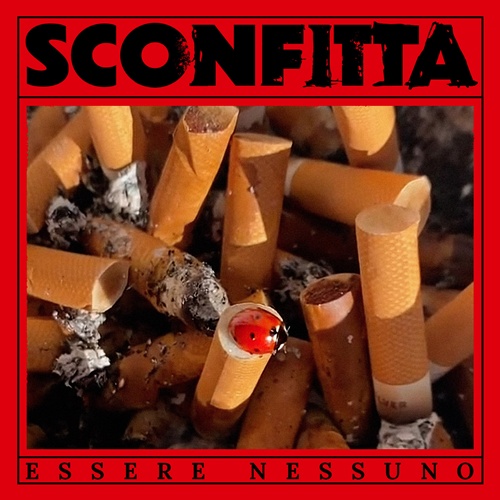
La copertina di “Essere Nessuno” mostra un mucchietto di cicche di sigarette con una coccinella viva sopra: in qualche modo sembra contraddire il titolo della band e dell’album. Qual era la vostra intenzione con questa immagine, e come pensate che rispecchi il messaggio complessivo del progetto?
La foto di copertina è stata catturata da un caro amico tatuatore di Roma – Alessandro Lemme. Caso volle che mi mandasse la foto esattamente il giorno in cui cominciavo a registrare le voci, così condivisi l’immagine con gli altri Sconfitti e capimmo tutti e subito che quella doveva essere l’immagine che avrebbe rappresentato l’album. La contraddizione tra il concetto di Sconfitta e l’iconografia di una coccinella sopra un cimitero di mozziconi di sigarette è in realtà solo apparente: quella coccinella, esistendo e resistendo da sola, racconta in maniera perfetta quello che volevamo trasmettere. Citando una parte del “Libricino Per Nessuno”: “Forse solo quando si siano abbandonate smanie di vittoria, sogni, brame e ambizioni: solo quando ci si trovasse ad essere sconfitti: solo quando non avrà più importanza né vincere né perdere, si riuscirà finalmente a guardare negli occhi il mondo e riscontrare barlumi di umanità, e radianti esempi di resistenza e coraggio. Come una coccinella che resiste sopra i fumi della (in)civiltà”.
Guardando al futuro, quali sono i vostri prossimi obiettivi come band? Ci saranno nuovi live, collaborazioni o esplorazioni stilistiche per continuare a sorprendere chi vi segue?
Non credo Sconfitta esisterà mai in sede live, specie se inteso come spettacolo. Mi piace andare ai concerti, ma non credo che faccia per noi salire su un palco e suonare a memoria le nostre cose. Vedremo. Al momento stiamo organizzando alcune presentazioni, specificamente in negozi di dischi indipendenti, librerie e centri studi libertari. Per adesso abbiamo confermato Genova e Roma, e spero di poter aggiungere altre date in giro per l’Italia. L’idea è quella di introdurre Sconfitta come concetto, come collettivo, piuttosto che come prodotto. Abbiamo anche già iniziato a scrivere nuova musica, e siamo a circa metà album nuovo pronto. Abbiamo fatto una bella esperienza insieme, sia in termini di songwriting che di produzione, e adesso credo che abbiamo voglia di mettere alla prova se e quanto abbiamo davvero imparato dai nostri limiti, sperimentando nuovi approcci e sonorità diverse. Ma senza fretta.
We had a chat with Simone from Sconfitta, the collective behind the album “Essere Nessuno”, released on May 1, 2026. The record comes together with the “Libricino Per Nessuno”, a written companion that expands and deepens the themes explored in the songs. Blending hardcore punk, metal, post punk, dark wave, jazz and some unexpected influences, the project moves well outside the traditional band framework, presenting a collective and strongly conceptual vision of music. In this interview we talked about the birth of the project, the stylistic choices behind it, and the meaning of a work that proudly embraces the freedom to fail.
Hi Simone, thanks for being here with us at Il Raglio Del Mulo! Your first album “Essere Nessuno” is accompanied by the “Libricino Per Nessuno” and was released on May 1, 2026. Can you tell us how this project was born and what message you want to convey through music and the book?
Hi Raglio Del Mulo, thanks for having us here. Sconfitta is a project conceived to be more of a collective than a band in the strict sense. Sure, we are three musicians, but we’re also a group of friends who have no particular interest in getting into the mechanisms of commodifying our own music, which would inevitably turn it into a product to market and sell. Instead, we’d rather embark on a new adventure specifically to make new friends and reach out to people who, like us, see their own struggles as a way to connect with others. The message of Sconfitta is simple but also layered: nowadays there is a constant pressure to be someone, to succeed in everything you do, to be winners at all costs. Well, in our own small way we want to help defend (and spread) the freedom to fail, which historically has always been part of every counterculture – or at least it was, as long as countercultures actually existed and resisted.
Your music blends hardcore punk, metal, dark wave, post punk and jazz, and I even sensed a bit of Teatro Degli Orrori in there. You mention Negazione, Mr Bungle, Refused, Hüsker Dü and, surprisingly, Johnny Dorelli as influences. While the others are easy to spot, what exactly is the Dorelli component in your sound?
During the recording phase, many of the ideas we had while writing the demos were reinterpreted and, in some ways, pushed to extremes. That made them fertile ground for experimenting with arrangements that are objectively alien to the punk and metal context. While playing some parts on piano and fretless bass, I sang a bit in a Johnny Dorelli style. Dorelli actually started as an inside joke, something that made us laugh, but like many other things we say and do, there’s probably something real behind it as well. People take themselves way too seriously: the methods of professional music-making (by a few) are often blindly replicated and applied at every level. As a result, even genres that could be free from rigid structures end up trapped inside fixed canons, and even the way many bands communicate becomes identical. So yes, there are parts in the songs on “Essere Nessuno” that formally recall the swing and jazz sensibility of early Johnny Dorelli, but for us mentioning him is also a political gesture, a way of breaking away from the overly serious tone that many bands use when defining themselves.
From a songwriting perspective, “Essere Nessuno” has a very fluid and almost schizophrenic approach to different genres. Did those influences naturally find their way into your compositions, or did you already have a clear idea from the beginning of what direction your music would take?
We wrote the songs very freely, without particular expectations or a strict blueprint to follow. The direction we wanted to take was clear only in a general sense, meaning that we wanted to stay compositionally free from predefined structures. I put together the first demos myself, drawing on riffs both from me and from Giorgio. We have very different ways of writing and composing, and different ears as well. One thing we often do, for example, is play each other’s riffs without using sheet music or tabs, leaving room for interpretation and even for mistakes. I’ve spent years making music and I know how many people want things to sound exactly the way they imagined them. It’s liberating to collaborate with someone who can not only destroy one of your songs, but who also shares and accepts the idea that you might destroy theirs.
The production of “Essere Nessuno” manages to unite very different sounds while keeping a strong and clear identity. How did you work together to balance the more aggressive elements with the more experimental ones?
We didn’t want to simply apply the same range of sounds across the entire album – which is often a trait of punk and metal – but rather introduce different frequencies and levels that could adapt to the needs of each individual song. We emptied and filled the tracks by alternating traditional punk and metal instruments with others capable of providing different textures, such as fretless bass, piano, synths, cowbell and acoustic guitars. In that sense, we treated “Essere Nessuno” more like a compilation of singles from a production standpoint rather than as a strictly homogeneous work, while still trying to make everything sound good as a whole.
The “Libricino Per Nessuno” accompanies the album and expands the band’s themes. How important was it for you to integrate written words with music, and what kind of dialogue do you hope to create with those who read and listen?
We jokingly say that we lose (lose, not take) the idea of being nobody very seriously, and a little book that nobody will read is an essential complement to an album that nobody will like. Regardless of how it will be received, the truth is we wanted to give more space to the themes addressed in the lyrics. When you sing, you realize that writing lyrics is often an exercise in synthesis: you search for words that can interact with the music, and in doing so you inevitably silence many of the words that form the backbone of the underlying ideas. I believe all our lyrics are political, and we wanted to give proper space to concepts that, if left only as song lyrics, might end up sounding like little lectures. The “Libricino Per Nessuno” is a little book for all the nobodies – just like us. A little book for those who are free from the dogmas of prepackaged answers offered by parties and religions, and who embrace and embody defeat in this masquerade ball of people who only care about winning.
I have the digital version of the record. In the physical edition, will there be a box including both the album and the book, or will the text only be available as a digital download?
Both the album and the little book will be available as free downloads. However, we have also printed some CD copies of the album and some physical copies of the book, which anyone interested will be able to purchase at a price that is roughly the cost of production.
Your sound is extremely varied and sometimes unpredictable. Are there any anecdotes or particular moments during the writing or rehearsal process that surprised you, or that changed the direction of a song?
Aside from the very fast and somewhat instinctive songwriting process, as I mentioned earlier the production aspect took us a lot of time and effort, leading us to revisit many sections in the studio that were eventually rewritten and performed differently on the record. We tried to approach the music with a lot of freedom, especially regarding how well we thought we knew the songs we ourselves had written. All the members of Sconfitta have previous experience and have recorded many albums with other projects in the past. This time we wanted to move away from the idea of putting rigid ideas onto tape, and instead use our time together in the studio as time to improve, change, and if necessary completely reshape the songs. It takes courage to do something like that, and a lot of openness to accept that a song you wrote and believed should sound a certain way might suddenly sound completely different. We pushed ourselves well beyond what I would call our comfort zone, especially with some vocal parts that were improvised on the spot – yes, there’s Johnny Dorelli in there, but somewhere along the way Tom Araya also came out instinctively, along with background screams and vocal harmonies that I originally didn’t think I wanted, or even knew how, to do.
The cover of “Essere Nessuno” shows a small pile of cigarette butts with a living ladybug on top. In a way it seems to contradict the title of both the band and the album. What was your intention with this image, and how does it reflect the overall message of the project?
The cover photo was taken by a dear friend of ours, a tattoo artist from Rome – Alessandro Lemme. By coincidence, he sent me the photo on the exact day I started recording the vocals, so I shared it with the other Sconfitti and we immediately understood that it had to be the image representing the album. The contradiction between the concept of Sconfitta and the image of a ladybug standing on a cemetery of cigarette butts is actually only apparent. That ladybug, simply by existing and resisting on its own, perfectly tells the story we wanted to convey. Quoting a passage from the “Libricino Per Nessuno”: “Perhaps only when the craving for victory, dreams, desires and ambitions have been abandoned; only when one finds oneself defeated; only when it no longer matters whether one wins or loses, will it finally be possible to look the world in the eyes and notice glimpses of humanity, and radiant examples of resistance and courage. Like a ladybug resisting above the fumes of (in)civilization.”
Looking ahead, what are your next goals as a band? Will there be new live shows, collaborations or stylistic explorations to keep surprising those who follow you?
I don’t think Sconfitta will ever really exist in a live setting, especially if we think of it as a show. I enjoy going to concerts, but I don’t think it’s for us to go on stage and play our songs by heart. We’ll see. Right now we’re organizing some presentations, specifically in independent record stores, bookstores and libertarian study centers. So far we have confirmed Genova and Rome, and I hope to add more dates around Italy. The idea is to introduce Sconfitta as a concept, as a collective, rather than as a product. We’ve also already started writing new music and we’re about halfway through a new album. We had a great experience together, both in terms of songwriting and production, and now I think we want to test how much we’ve actually learned from our limits by experimenting with new approaches and different sounds. But without rushing it.
 Il Raglio del Mulo
Ottima intervista per un ottimo progetto
"Mi piace""Mi piace"
Grazie mille! 🤘💀🫏
"Mi piace""Mi piace"