

ENGLISH VERSION BELOW: PLEASE, SCROLL DOWN!
Dopo aver condiviso la loro esperienza su Il Raglio del Mulo in occasione dell’uscita di “At Night We Prey”, i veterani del metal greco Nightfall tornano per una nuova, intensa conversazione. Questa volta, presentano il convincente nuovo album “Children of Eve”, pubblicato tramite Season of Mist. Le risposte alle nostre domande sono state fornite dal frontman Efthimis Karadimas, che ci guida attraverso i temi, la produzione e i profondi messaggi racchiusi nella musica degli ellenici.
Efthimis, bentornato! Nella nostra precedente conversazione incentrata su “At Night We Prey”, avevi condiviso coraggiosamente le tue esperienze con la depressione e la speranza di affrontare questo tema cruciale attraverso la musica. Come stai oggi?
Ciao Giuseppe! Grazie per avermelo chiesto, amico mio. Mi sento meglio rispetto a prima; parlare apertamente della depressione mi ha fatto ritrovare la fiducia per tornare a essere creativo. Ed è proprio questo che voglio condividere con tutti coloro che lottano con la salute mentale: possiamo conviverci, essere attivi e viverla con serenità.
Sulla scia della tua esperienza personale, i Nightfall hanno lanciato l’iniziativa Metal Music Against Depression (MMaD). In che modo “Children of Eve” contribuisce a questa iniziativa e alla discussione più ampia sulla salute mentale nella comunità metal? Ci sono passaggi specifici o messaggi generali nell’album che affrontano direttamente questo tema?
C’è decisamente un collegamento; “Children of Eve” parla di unità contro il bigottismo e l’intolleranza. Si riferisce principalmente alle tre religioni abramitiche che oggi causano più dolore che sollievo. Le persone che cadono vittime della propaganda religiosa sono spesso persone bisognose di credere in qualcosa, personalità spezzate dalla povertà e dalla paura di ciò che non comprendono, praticamente tutto il mondo. Queste persone diventano fanatiche ed esercitano la violenza molto facilmente. Hanno bisogno di aiuto. Non sono il vero cuore del problema. Il cuore sono i loro leader, che hanno una propria agenda geopolitica e li manovrano a proprio piacimento.
“Children of Eve” è descritto come la creazione più oscura ed epica dei Nightfall. Quali erano gli obbiettivi musicali e lirici principali all’inizio dei lavori su questo undicesimo album? In che modo si differenzia, dal punto di vista sonoro e tematico, da “At Night We Prey”?
“At Night We Prey” parla di depressione e della lotta contro gli stereotipi sociali; “Children of Eve” parla di unità contro l’intolleranza e della lotta contro essa. Questo è il denominatore comune tra i due album. Dopo “At Night We Prey” mi sono sentito sollevato per essere riuscito a comunicare un tema così serio attraverso musica e testi contemporanei. Quel sollievo mi ha aiutato a rimettermi in piedi e a rifocalizzarmi. “Children of Eve” porta con sé l’entusiasmo di un bambino che riscopre il mondo e si arrabbia per le ingiustizie che vede.
Essendo “Children of Eve” descritto come un album che unisce “anime oscurate ovunque”, cosa speri che gli ascoltatori traggano da questo lavoro, sia in termini di impatto musicale che di messaggio sul dolore, la resilienza e l’importanza di parlare apertamente?
Voglio che le persone contrastino il bigottismo e l’intolleranza. Inoltre, è importante che i leader religiosi riconsiderino i loro insegnamenti. Non ha senso, nel 2025, dibattere ancora sul diritto all’aborto delle donne. Che siano le donne a decidere cosa fare del proprio corpo. Se i radicali religiosi prenderanno il controllo, perderemo tutte le nostre libertà, la scienza verrà degradata e i diritti che diamo per scontati saranno soppressi. Basta guardare cosa succede nei paesi governati da regimi teocratici. In Grecia, la Chiesa esercita ancora un’influenza politica. Stato e Chiesa non sono separati.
Nella nostra precedente intervista hai detto che i Nightfall operano per “stagioni” e che “Prey” ha segnato l’inizio della quarta stagione negli anni 2020. Potresti approfondire questo approccio “cinematografico” alla pubblicazione degli album? Cosa riserva questa nuova stagione ai Nightfall in termini di direzione musicale e tematiche?
Analizzando la discografia dei Nightfall, si nota che è scandita dai cambiamenti di formazione e di etichetta ogni decennio. Negli anni ’90 eravamo con Holy, nei 2000 con Black Lotus, nei 2010 con Metal Blade e ora, nei 2020, con Season of Mist. Spero che questa collaborazione duri molto più di un decennio e che avremo modo di pubblicare ancora molti album e andare in tour. La caratteristica di questa nuova stagione è il nostro ritorno sui palchi come live band e, ovviamente, il ritorno presso un’etichetta francese che amiamo moltissimo.
La tracklist presenta titoli come “I Hate”, “The Cannibal” e “The Traders Of Anathema”, che spesso richiamano temi religiosi con una prospettiva critica. Potresti approfondire i contenuti lirici e i messaggi che intendi trasmettere con questi brani?
L’intero album parla di come le religioni organizzate manipolino i fedeli. È terribile vedere, nel 2025, persone sacrificare la propria vita in nome di dei rappresentati da leader religiosi che perseguono agende geopolitiche. Apparentemente, le tre religioni abramitiche causano più dolore che sollievo. Analizzando il profilo dei credenti si capisce che si tratta di persone semplici, che reagiscono ai richiami dei loro leader. Diventano fanatici e gli altri li considerano il male assoluto. Ma non è così. Non si può incolpare un radicale per la sua aggressività se il suo stesso leader religioso non gli ha insegnato veramente ad amare e ad accettare gli altri. Il bigottismo e l’intolleranza stanno guadagnando terreno, anche in società dove non era normale. Eventi geopolitici hanno portato questi problemi anche nelle nostre comunità, con minoranze radicali che trovano ora giustificazioni per esprimere il proprio odio. Se tuo figlio si comporta male, da buon genitore cerchi di correggerlo. Se non lo fai, sei responsabile delle sue azioni. E parlo di azioni attuali, non future. È la solita storia della manipolazione delle masse, che va avanti da secoli. Cerco amore nei testi religiosi, ma trovo odio. Dio ha maledetto tutte le donne con nove mesi di dolore per il parto come punizione per la scelta di Eva. Una punizione collettiva di tale portata dovrebbe essere denunciata, perché è alla base della cosiddetta religione dell’amore. È come condannare per sempre tutti i tedeschi per ciò che è successo 80 anni fa. Non esiste nulla di più barbaro della condanna collettiva. In risposta simbolica a quella cacciata, invochiamo l’unità. Abbracciamo nostra madre Eva, che ebbe il coraggio di ribellarsi al suo padrone vendicativo.
Hai collaborato con l’ex batterista dei Septicflesh, Fotis Benardo, e con il chitarrista degli InnerWish, Thimios Krikos, per la produzione di “Children of Eve”, mentre Jacob Hansen si è occupato di mix e mastering. In che modo questa collaborazione ha modellato il suono monumentale che volevi raggiungere? Cosa ha portato ognuno di loro al processo produttivo?
Fotis è un membro attivo dei Nightfall. Thimios è un buon amico. Sono andato nel suo studio a registrare il demo dei nuovi brani e poi l’ho presentato al resto della band. Amo il lavoro di squadra. È difficile e so che molti musicisti preferiscono fare tutto da soli. Ma adoro la sfida di presentare un’idea agli altri e svilupparla insieme. È un lavoro di squadra, ed è questo che lo rende speciale. Abbiamo lavorato molto per ottenere il suono di “Children of Eve”. Anche Jacob Hansen ha messo la sua magia.
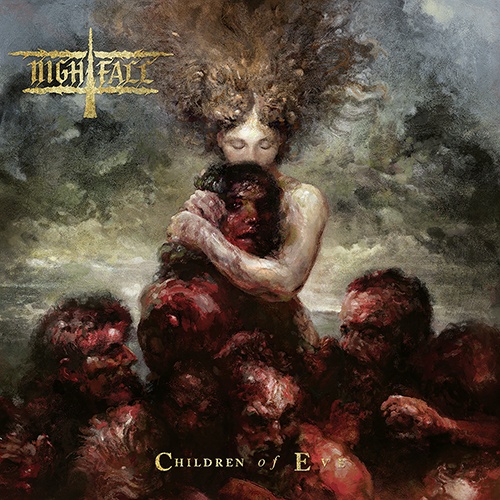
La copertina di “Children of Eve” è stata realizzata da Eliran Kantor, su un tuo concept. Qual era la visione dietro l’artwork e come rappresenta visivamente i temi e l’atmosfera dell’album?
L’ho contattato, gli ho parlato del concept, gli ho mandato i demo, i testi e molte riflessioni. Ha fatto un ottimo lavoro. Sento che ha messo un impegno extra per i Nightfall, anche perché è un nostro vecchio fan, e ha prestato grande attenzione a catturare l’atmosfera e tutto ciò che riguarda la nostra arte. Amo questa copertina. È un vero artista. Il messaggio principale è l’unità. Dobbiamo restare uniti contro il bigottismo e l’intolleranza. Compassione, supporto e comprensione sono fondamentali per ogni individuo. Uccidersi in nome della fede, qualunque essa sia, non è un bene. Dietro ogni cadavere c’è una madre che piange e chiede vendetta. Così il dolore e la morte continuano a distruggere i sogni e le vite delle persone.
Con l’uscita di “Children of Eve” ormai imminente, ci sono piani di tour o concerti live in programma per supportare il nuovo album?
Stiamo discutendo tutte le opzioni di tour. Vogliamo tornare sulla strada e suonare il più possibile. “Children of Eve” suona ancora meglio dal vivo!
After previously sharing their sory on Il Raglio del Mulo during the release of “At Night We Prey“, Greek metal veterans Nightfall are back for another heartfelt conversation. This time, they return with their powerful new album “Children of Eve“, released via Season of Mist. The answers to our questions were provided by frontman Efthimis Karadimas, who dives deep into the album’s themes, production process, and the important messages behind their music.
Efthimis, welcome back! In our previous conversation surrounding “At Night We Prey”, you bravely shared your experiences with depression and your hopes of addressing this crucial issue through your music. How are you doing today?
Hello Giuseppe! Thanks for asking my friend. I feel better than previously; talking openly about depression made me regain confidence to become creative again. And this is exactly what I wanna share with everybody struggling with mental health out there. We can live with it, be active and be cool about it.
Following your own experiences, Nightfall has launched the Metal Music Against Depression (MMaD) initiative. How does “Children of Eve” contribute to this initiative and the broader conversation around mental health within the metal community? Are there specific lyrical passages or overall messages on the album that directly address this?
There is indeed a connection; “Children of Eve” is about unity against bigotry and intolerance. It mainly refers to the three Abrahamic religions that cause more pain than relief these days. People who normally fall victims of religious propaganda are people who need to believe in something. Most of them are broken personalities, because of poverty and fear of everything they don’t understand; practically the entire world. These people become fanatics and exercise violence very easily. These people need help. They are not the heart of the problem. The heart is their leaders who have their own geopolitical agenda and move these poor people as per their plan.
“Children of Eve” is described as Nightfall’s darkest and most epic creation yet. What were the key musical and lyrical intentions you had when you began working on this eleventh studio album? How does it sonically and thematically differ from “At Night We Prey”?
“At Night We Prey” is about depression and how to fight social stereotypes; “Children of Eve” is about unity against intolerance and how to fight about it. That’s the common denominator between the two. After “At Night We Prey” I felt relieved for managing to communicate something so serious like depression through contemporary music and lyrics. That relief helped me to stand on my feet again and refocus. “Children of Eve” carries the excitements of a kid who rediscovers the world and gets angry about things that are wrong.
With “Children of Eve” being described as uniting “blackened souls everywhere,” what do you hope listeners will take away from this album, both in terms of its musical impact and its underlying message about pain, resilience, and the importance of speaking out?
I want people to block bigotry and intolerance. Furthermore, it is important for religious leaders to reconsider their teachings. It makes no sense to debate about women’s right in abortion, in 2025. Let women decide what to do with their bodies. If religious radicals take control, we all gonna lose our freedoms, science will be degraded, things we take for granted will be suppressed. Just see what’s going on in places where theocratic regimes are in power. In Greece, church has a political influence. State and church are not separated.
You mentioned in our previous interview that Nightfall operates in “seasons,” and “Prey” marked the beginning of the fourth season in the 2020s. Could you elaborate on this “cinematographic” approach to releasing albums? What does this new season hold for Nightfall in terms of musical direction and thematic exploration?
Going through Nightfall discography, one realizes that it’s based on line up and label changes every decade. We were with Holy in the 90s, then Black Lotus in the 00s, Metal Blade in the 10s and Season of Mist in the 20s. I hope we stay together much longer than a decade and have the chance to release more albums and make tours. The new season’s characteristic is our return to the stages as a live act, and of course our return to a French label that we so much adore.
The tracklist reveals titles like “I Hate,” “The Cannibal,” and “The Traders Of Anathema,” often referencing religious themes with a critical perspective. Could you delve into the lyrical content and the messages you aim to convey through these particular songs?
The entire album is about how organized religions manipulate believers. Witnessing in 2025 people sacrificing their lives in the name of gods represented by a bunch of religious leaders who have a geopolitical agenda is a horrible view. Apparently, the three Abrahamic religions cause more pain than they claim they cure. Studying the profile of believers of all three, one can easily understand that they are simple humans who react to the calls of their leaders. They become fanatics and the rest think of them as the root of all evil. But it’s not. None can blame a radical for being aggressive if the very leader of the religion he acts for has not taught him truly about how to love and accept others. Bigotry and intolerance is gaining momentum. And if that was normal to theocratic regions, like most of the Arab nations, it was not elsewhere. Regretfully, geopolitical events have brought this problem to our societies, with radical minorities here finding the best excuse to show how good they are in practicing bigotry and intolerance too. If your child acts in bad ways, you as prudent parent are going to put extra effort into explaining to it what’s wrong with such behavior. If you let it, then you are responsible for its actions. And I am not talking about future actions, but current. It’s the known story about manipulation of the masses that goes on for centuries. I try to find love in the writings, but I see hate. God cursed all women to 9 months of painful labour, when about to become mothers, as a punishment for Eve’s choice to act her will. A collective punishment of such proportion that it should be denounced stands in the very heart of the so-called religion of love. It’s like condemning all Germans forever for someone’s wrong doings 80 years ago. There’s nothing more barbaric than a collective condemnation. In a symbolic response to that action of expulsion, we call for unity. Let us all embrace our precious mother Eve, who had the guts to rebel against her vengeful master.
You’ve collaborated with former Septicflesh drummer Fotis Benardo and InnerWish guitarist Thimios Krikos on the production of “Children of Eve,” and Jacob Hansen handled mixing and mastering. How did this collaborative effort shape the monumental sound you aimed for on the album? What did each of them bring to the production process?
Fotis is an active member of Nightfall. Thimios is a good friend. I went to his studio to record the demo with the new tracks, and then I presented it to the rest in the band. I love team work. It is a difficult task and I know many musicians prefer to do everything by themselves. But I love the challenge of presenting the idea to the rest and then going through this altogether. It’s a team effort and that makes it great. We worked a lot to get the sound production of “Children of Eve”. Jacob Hansen put his magic too.
The artwork for “Children of Eve” was created by Eliran Kantor, and the art concept was yours. What was the vision behind the cover art, and how does it visually represent the themes and atmosphere of the album?
I got in touch with him, talked about the concept, sent him a demo, lyrics and lots of thoughts about it. He well delivered. I feel he walked the extra mile for Nightfall, because he is an old fan of the band and paid extra attention to capture the atmosphere and everything about our art. I love this artwork. He is a true artist. The main thing is the unity. We shall stand united against bigotry and intolerance. Compassion, support, and understanding are crucial factors for every individual. Killing each other in the name of faith, any faith, is not a good thing. Behind each dead body there’s a mother crying, asking for revenge. Hence, pain and killing continue to destroy people’s dreams and lives.
With the release of “Children of Eve” just around the corner, are there any touring plans or live performances in the works that fans can look forward to in support of the new album?
We are currently talking about all touring options. We wanna hit the road and play extensively. Children of Eve sounds even better live!

