

ENGLISH VERSION BELOW: PLEASE, SCROLL DOWN!
Il Purgatorio non è un luogo di attesa, almeno per i Darkhold: è un campo di battaglia, una lenta ascesa tra colpa, paura e ossessione, scandita dal peso dei sette vizi capitali. Con “Centuries Of Purgatory”, pubblicato da Nadir Music, la formazione italiana firma un concept album che rifiuta ogni compromesso, affondando lo sguardo nella parte più oscura dell’essere umano anziché cercare facili vie di fuga. Abbiamo raggiunto Claudio per addentrarci nelle viscere di un’opera che non chiede semplicemente di essere ascoltata, ma vissuta fino in fondo.
Ciao e benvenuto su Il Raglio Del Mulo! Grazie per il tempo che ci dedichi e complimenti per l’uscita di “Centuries Of Purgatory”, un disco che segna un nuovo capitolo per i Darkhold e che promette di ridefinire il vostro modo di interpretare il thrash metal. Dopo tanta attesa e un lungo percorso creativo, quali sensazioni state vivendo ora che il pubblico può finalmente ascoltare questo lavoro?
Ciao a tutti i lettori de Il Raglio Del Mulo e assolutamente grazie a voi per lo spazio che ci state dando per raccontare un po’ di noi e del nostro nuovo album. “Centuries Of Purgatory” ha poco più di un mese di vita e già ci sta regalando soddisfazioni notevoli in termini di apprezzamento da parte del pubblico, visibilità, vendite e opportunità live, dove può esprimere tutta la sua potenza e dove ha fatto smuovere un bel po’ di teste e di corpi. In sole tre settimane abbiamo avuto la possibilità di suonarlo live per intero al nostro release party l’11 luglio alla Cripta di Cusano Milanino e di proporre alcuni brani sui palchi molto prestigiosi del Luppolo In Rock a Cremona domenica 19 luglio e del Rock And Bol a Bolotana, in Sardegna, sabato 25 luglio: esperienze a dir poco esaltanti, con il pubblico preso benissimo, poghi, wall of death, cori, headbanging sfrenati, seguiti da foto, autografi e complimenti a profusione. Direi che chiedere un inizio migliore di questo nuovo capitolo fosse assolutamente impossibile e, credetemi, è solo l’inizio.
Il titolo “Centuries Of Purgatory” richiama immediatamente immagini di sofferenza, espiazione e sospensione nel tempo. Quale significato assume questo concetto all’interno del disco e come si intreccia con i temi affrontati nei testi?
In questo album, rispettando la costruzione dantesca del Purgatorio, vengono vissuti in nove tracce i sette vizi capitali, il vero cuore di tutta l’opera, protetti da un Antipurgatorio iniziale e da un Paradiso Terrestre finale, e il tutto è vissuto come un nuovo viaggio nei meandri più oscuri ma terribilmente tangibili della perversione e dell’animo dell’umanità. Un’umanità familiare: quella del vicino di casa, dell’amico, del parente stretto; quella che si può toccare, vivere, respirare, subire; quella per cui può cambiare tutto, nel bene e nel male, e che a sua volta ti cambia dentro, nel profondo; quella che non ti lascia scampo, perché ne sei schifato ma anche attratto, senza possibilità alcuna di sottrarti a essa. C’è un’inesorabilità di fondo che è disarmante, una dipendenza incontrovertibile, un’impossibilità di disintossicazione talmente palese che pare di stare con le gambe bloccate nel fango fino alle ginocchia: una situazione talmente critica dalla quale, per liberarsi, si è inevitabilmente obbligati a lasciare indietro per sempre qualcosa di sé stessi, pagando un prezzo inimmaginabile.
Pur restando ancorati al thrash metal della Bay Area che ha plasmato le vostre origini, in “Centuries Of Purgatory” emergono sfumature più oscure e introspettive. Da dove nasce l’esigenza di esplorare territori emotivi differenti e quanto è stato naturale integrare questa nuova dimensione senza tradire il DNA dei Darkhold?
“Centuries Of Purgatory” rappresenta la naturale evoluzione della band, delle persone che la compongono e della musica che creano, con lo scorrere della vita quotidiana, vero perno di tutto l’album. Se “Tales From Hell” definiva l’Ucronia di un passato fantastico immerso in una visione infernale dell’esistenza, questo nuovo album è letteralmente radicato nell’Agonia di un presente asfissiante e malato: i peccati non sono più attribuibili a possibili scelte sbagliate a seconda di strade diverse intraprese, ma sono paurosamente ancorati a decisioni volute, giornalmente perpetrate perché contemporaneamente schiave e dominatrici del relativo peccato, che non a caso in Purgatorio viene chiamato e ben definito come vizio. Un vizio è chiaramente di base un peccato, ma è ancora più subdolo perché è ragionato, voluto, temuto, desiderato; un “Odi Et Amo” dal quale non ci si riesce a liberare. A livello personale negli ultimi anni siamo cambiati, abbiamo affrontato la quotidianità delle nostre vite, con i loro problemi e le loro sfide, abbiamo visto fare la stessa cosa al mondo che ci circonda, e quindi oggi come non mai il Purgatorio e i suoi vizi strisciano indisturbati sulla Terra senza freno alcuno. Tutto ciò è decisamente marcato sia nei testi sia nella musica di “Centuries Of Purgatory”, nel quale contemporaneamente si possono trovare energia e disperazione, volontà e arrendevolezza, tutto comunque subordinato a un’enorme paura di base.
“Roots Of Arrogance” è stato scelto come anticipazione dell’album e rappresenta con grande efficacia la vostra energia più feroce. Quali elementi del brano lo hanno reso la scelta perfetta per introdurre il pubblico a questa nuova fase della band?
“Roots Of Arrogance” è decisamente il brano più moderno e difficile da eseguire che abbiamo scritto finora e devo dire che soprattutto in sede live il pubblico lo sta apprezzando molto, sia per la dinamica veloce e compatta sia per i tecnicismi, senza dimenticare ovviamente il tema portante del primo vizio capitale della superbia, di cui ogni parte di testo è intrisa. Oggi più che mai siamo di fronte a continue manifestazioni di arrogante superbia in ogni campo: politica, religione, cultura, lavoro, rapporti sentimentali o semplicemente di civile dialogo, quest’ultimo sicuramente con un impatto maggiore proprio perché è di gran lunga numericamente superiore a tutte le altre voci messe insieme. L’uomo nella sua quotidianità è sempre più predatore verso il prossimo, con il desiderio costante di manifesta superiorità sotto tutti i punti di vista e giustificando ogni comportamento con il diritto alla vita e il desiderio di sopravvivenza, ma di base c’è un odio di fondo che giustifica atti di intolleranza continua e mal sopportazione di ogni forma di idea che non sia subordinata alla propria. Tutti vogliono sentirsi superiori a qualcun altro pur di avere potere libero e privo di controllo e/o di giudizio da parte del prossimo, ma così facendo l’escalation verso una guerra fratricida diventa quotidiana e incontrollabile.
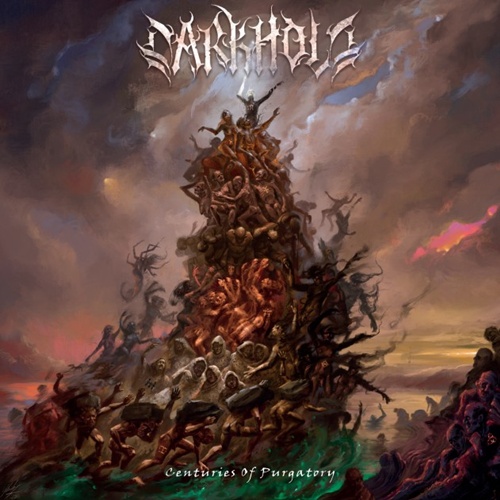
Un ruolo fondamentale nell’identità del disco è affidato anche all’imponente lavoro grafico realizzato da Sheila Franco. Quanto è stato importante trovare una traduzione visiva capace di riflettere l’oscurità e la profondità emotiva delle nuove composizioni?
Tutto va di pari passo, così come è stato per il primo album. Per rappresentare al meglio le tematiche di “Centuries Of Purgatory” abbiamo appositamente scelto un’artista pazzesca come Sheila Franco e lo abbiamo fatto perché il suo stile pittorico è proprio quello che volevamo da tempo e che eravamo sicuri avrebbe dato la migliore visione del nostro percorso tematico e musicale, non solo per il suo stile o per la scelta cromatica che tutti avete potuto ammirare, ma in particolar modo per la dinamicità che volevamo dare ai movimenti degli abitanti del Purgatorio rappresentati in modo strabiliante nella piramide umana dipinta in copertina, a definire ognuno dei vizi capitali nei minimi particolari, con la simbologia giusta marchiata a fuoco sulla loro pelle, in un turbine di disperazione e fatica nel cammino verso la cima, la luce, la speranza o forse la vera fine. Giudicate voi l’operato di questa artista tutta italiana, per noi assolutamente straordinario, e che spero verrà elogiato ovunque e le permetterà di raggiungere il successo che merita, perché quando l’arte trascende sé stessa allora siamo di fronte a talenti puri che vanno preservati e protetti ma al contempo esaltati e celebrati.
Arrivati al secondo album, si acquisisce inevitabilmente una maggiore consapevolezza del proprio percorso. Quali insegnamenti vi siete portati dietro dall’esperienza del debutto e in che modo hanno influenzato le scelte artistiche compiute per “Centuries Of Purgatory”?
I Darkhold sono una concept band già per definizione, dove il concetto del peccato viene sviscerato, analizzato e amplificato in ogni sua forma e genere, quindi ogni album è un capitolo nuovo nella composizione del Libro Dei Peccati. Proprio per questo motivo il percorso della band, e di ciò che la band ha espresso dal principio, vuole esprimere ed esprimerà in futuro, è già ben definito e consapevole, soprattutto nella mia testa visto che sono l’artefice di tutto il comparto ideologico del progetto. Come artisti e musicisti nessuno di noi è di primo pelo: abbiamo tutti più di almeno vent’anni di esperienza compositiva e live, addirittura chi quasi trenta o anche più, e proprio le nostre esperienze personali sono confluite in questo nuovo progetto in modo molto deciso ed equo, dove ognuno di noi fa la propria parte, come una vera band coesa e desiderosa di proporre la propria visione amalgamata con quella degli altri membri della band. Tutto ciò è scaturito prima in “Tales From Hell”, che ha avuto più tempo a disposizione per essere creato, provato e assimilato e per poter fare da apripista al concetto di questo progetto verso il pubblico, e poi in “Centuries Of Purgatory”, un album decisamente più immediato, urgente, in parte costruito, affinato e completato in appena sette mesi, dove la sofferenza dei temi trattati, ma anche la tensione all’interno di noi stessi, sono state talmente concrete e palpabili da farci spesso scontrare a tal punto da farci vivere di persona alcuni dei peccati di cui stavamo trattando, quasi in un’interpretazione stanislavskijana dei brani che stavamo componendo. Non nascondo che è stata dura, ma è stato tutto molto istruttivo perché ha aperto in noi nuove visioni reciproche di noi stessi, tanto da darci nuovi spunti per il futuro, sia a livello personale sia come musicisti e band.
La copertina di “Centuries Of Purgatory”, realizzata da Sheila Franco, colpisce per la sua monumentalità e per quella piramide di anime dannate che sembra raccontare una storia ancora prima dell’ascolto del disco. Quali simboli e significati avete voluto racchiudere in quest’opera e quanto è stato importante costruire un dialogo così stretto tra dimensione visiva e musicale?
L’idea della copertina mi è venuta da un’opera scultorea realizzata dal veneziano Francesco Bertos tra il 1725 e il 1735, “La Caduta Degli Angeli Ribelli”, tutt’oggi visibile ed esposta in modo permanente all’interno delle Gallerie d’Italia di Palazzo Leoni Montanari a Vicenza. Partendo dalla visione di questo ammasso di corpi, caduti dal Paradiso e in preda alla disperazione per la perdita di tutto ciò che avevano, ho rielaborato il concetto dei corpi in una spirale contraria, verso l’alto, dove le anime del Purgatorio, divise in cerchie, tentano di risalire l’una sopra l’altra per liberarsi dal giogo di un’eternità inesorabile e raggiungere uno spiraglio di speranza rappresentato dalla luce alla sommità di questa struttura conica, come una visione celestiale e di perdono purificatore. Oltre che per l’Antipurgatorio e per l’entrata al Paradiso Terrestre, per ogni cerchia dei vizi capitali c’è un peccato, per ogni peccato ci sono moltitudini di anime e per ognuna di esse c’è un loro rappresentante marchiato a fuoco con un simbolo specifico e personale (guardate bene la copertina e li troverete tutti e nove…), un paria talmente estremo per i peccatori stessi da meritare la marchiatura a fuoco ma anche la loro guida spregiudicata verso la speranza del perdono eterno, sempre che ce ne sia uno. Proprio questa insicurezza fa crescere nei peccatori del Purgatorio (che non siamo nient’altro che noi stessi, uomini sulla Terra) la paura sempre più marcata che quello che stiamo facendo per raggiungere quell’obiettivo sia in realtà tutto inutile, una presa in giro, una farsa, ma nonostante ciò cresce in noi in modo costante la necessità di crederci, di andare avanti senza sosta, di sperare e di compiere le peggiori nefandezze in nome di tutto ciò.
La scena metal italiana continua a mostrare grande vitalità e nuove realtà emergono costantemente. Dal vostro punto di vista, quali sono oggi le sfide più significative per una band che vuole mantenere una forte identità artistica senza inseguire le mode del momento?
Semplicemente essere sé stessi, caro Giuseppe, che sembra la solita banalità da scrivere ma è davvero l’unica cosa che conta, perché proprio da quell’essere sé stessi ogni giorno nascono le idee migliori e più originali, non influenzate dalle sempre più numerose mode del momento per distinguersi dalla massa, creare finto hype e fare cassa. Personalmente non apprezzo determinati filoni metal che in Italia nascono, crescono e muoiono nel giro di pochi anni, un usa e getta di idee potenzialmente valide a livello creativo che però scemano quasi subito in favore di una forzatura impositiva dell’immagine estetica a discapito dell’evoluzione musicale, con il sempre più frequente abuso di basi preregistrate, sample campionati a oltranza, elettronica sempre più invadente, compressioni spasmodiche per rendere, per esempio, “ciccioso” il suono innocuo di un riff ancora più innocuo. Ho sempre preferito i musicisti che si creano un loro suono personale, frutto di ricerca, un marchio di fabbrica riconoscibile nel corso degli anni e delle esperienze, non schiavo degli artifici, piuttosto che gli intrattenitori da palco con armature, spadoni, elmi, prese per il culo parodistiche, papere giganti, pentole e coperchi, trucchi improponibili e movenze plasticose, spettacoli costruiti talmente finti che se ne accorgerebbe anche un sordo-cieco. Tanti ormai cavalcano quest’onda, tanti ormai non hanno argomenti, ma altrettanti invece si impegnano giorno per giorno per restare sé stessi e musicalmente spaccare di brutto senza se e senza ma.
Con l’album finalmente pubblicato e numerosi concerti già confermati tra Italia ed Europa, questo sembra essere soltanto l’inizio di una nuova fase per i Darkhold. Guardando oltre il presente, quali traguardi vorreste raggiungere nei prossimi anni e quali aspetti della vostra identità artistica sentite di voler sviluppare ulteriormente?
Per ora siamo molto concentrati sulla nostra recentissima nuova uscita discografica e sulla sua promozione, sia sui social sia dal vivo, con interviste scritte e/o video e, ovviamente, concerti ovunque, si spera, perché la dimensione live ci permette di far vivere al pubblico il messaggio che ogni nostra canzone vuole trasmettere. Non so quando inizieremo il processo per il prossimo album, è decisamente impensabile stabilirlo adesso ed è anche decisamente prematuro, nonostante ci siano già da tempo molte idee e una linea sia stata tracciata in tempi lontani, ma come dicevo prima l’imprevedibilità è sempre dietro l’angolo, così come le idee costruttive. Così come vorremmo che il miglior progetto fosse vedere più gente possibile nelle sale concerti per riscoprire l’importanza dell’interscambio reciproco tra artista e ascoltatore; magari le parti si potrebbero tranquillamente invertire e far nascere di conseguenza nuove idee e nuovi stimoli artistici… imprevedibilità… Come detto prima, il progetto Darkhold, in quanto concept che crea concept, è partito dall’Inferno e sta transitando in Purgatorio per arrivare, ovviamente, al Paradiso, quell’obiettivo tanto agognato da tutti anche se, in verità, nessuno se lo merita davvero. Nella nostra visione sarà proprio il frutto delle azioni della nostra vita purgatoriale sulla Terra a generare ciò che la “luce” in fondo al tunnel vorrebbe essere ma che, in verità, sarà ben diversa da ogni tipo di aspettativa creatasi precedentemente, esulando completamente dall’immaginario collettivo ma piuttosto basandosi su una visione destabilizzante di ogni realtà. Credo sia meglio fermarsi qui per evitare qualunque tipo di più che prematuro spoiler, senza però dimenticare che questi costrutti sono prettamente umani e, in verità, nello spazio e nel tempo c’è ben oltre: perché il peccato non ha padrone né creatore, se non sé stesso, non conosce confini o giurisdizioni emotive e fisiche, non ha pietà e non ha obiettivi reali, non avrà fine e non se ne trova il principio, trascende regole e leggi universali ma vuole solo una cosa: essere vissuto, respirato e divulgato. Il peccato vuole tutto, e lo avrà.
Purgatory is not a place of waiting, at least not for Darkhold: it is a battlefield, a slow ascent through guilt, fear and obsession, marked by the weight of the seven deadly sins. With “Centuries Of Purgatory”, released by Nadir Music, the Italian band delivers a concept album that refuses any compromise, staring into the darkest side of human nature instead of looking for easy ways out. We reached Claudio to dive into the depths of a work that does not simply ask to be listened to, but to be experienced to the fullest.
Hi and welcome to Il Raglio Del Mulo! Thanks for the time you are dedicating to us, and congratulations on the release of “Centuries Of Purgatory”, an album that marks a new chapter for Darkhold and that promises to redefine your way of interpreting thrash metal. After such a long wait and a long creative journey, what feelings are you experiencing now that the audience can finally listen to this work?
Hi to all the readers of Il Raglio Del Mulo and first of all thank you so much for giving us the chance to tell a little bit about ourselves and our new album. “Centuries Of Purgatory” has been alive for just over a month and it is already giving us remarkable satisfaction in terms of appreciation from the audience, visibility, sales and live opportunities, where it can express all its power and where it has already made quite a few heads and bodies move. In just three weeks we had the chance to play it live in its entirety at our release party on July 11th at Cripta in Cusano Milanino and to perform some songs on the prestigious stages of Luppolo In Rock in Cremona on Sunday July 19th and Rock And Bol in Bolotana, Sardinia, on Saturday July 25th: experiences that were nothing short of exhilarating, with the crowd completely into it, mosh pits, wall of death, chants, insane headbanging, followed by photos, autographs and compliments pouring in. I would say that asking for a better beginning to this new chapter would have been absolutely impossible and, believe me, this is only the beginning.
The title “Centuries Of Purgatory” immediately recalls images of suffering, expiation and suspension through time. What meaning does this concept take on within the album and how does it intertwine with the themes explored in the lyrics?
In this album, following Dante’s construction of Purgatory, the seven deadly sins are experienced across nine tracks, they are the true core of the entire work, protected by an initial Ante-Purgatory and a final Earthly Paradise, and everything is lived as a new journey through the darkest but terribly tangible depths of humanity’s perversion and soul. A familiar humanity: the one of the neighbour next door, the friend, the close relative; the one that can be touched, lived, breathed, suffered; the one through which everything can change, for better or worse, and which in turn changes you from within, deep inside; the one that leaves you no escape, because you are disgusted by it but also attracted to it, without any possibility of escaping from it. There is an underlying inevitability that is disarming, an undeniable addiction, an impossibility of detoxification so evident that it feels like having your legs stuck in mud up to your knees: a situation so critical that, in order to free yourself, you are inevitably forced to leave something of yourself behind forever, paying an unimaginable price.
While remaining anchored to the Bay Area thrash metal that shaped your origins, in “Centuries Of Purgatory” darker and more introspective shades emerge. Where does the need to explore different emotional territories come from, and how natural was it to integrate this new dimension without betraying Darkhold’s DNA?
“Centuries Of Purgatory” represents the natural evolution of the band, of the people who are part of it and of the music we create, with the passing of everyday life being the true cornerstone of the entire album. If “Tales From Hell” defined the uchronia of a fantastic past immersed in an infernal vision of existence, this new album is literally rooted in the agony of a suffocating and sick present: sins are no longer attributable to possible wrong choices depending on different paths taken, but are terrifyingly anchored to deliberate decisions, carried out day after day because they are at the same time slaves and masters of the relative sin, which is not by chance called and clearly defined as a vice in Purgatory. A vice is obviously a sin at its core, but it is even more subtle because it is thought out, desired, feared, wanted; an “Odi Et Amo” from which one cannot manage to break free. On a personal level, in recent years we have changed, we have faced the everyday reality of our lives, with their problems and challenges, we have seen the same thing happening to the world around us, and therefore today more than ever Purgatory and its vices crawl across the Earth without any restraint. All of this is strongly marked both in the lyrics and in the music of “Centuries Of Purgatory”, where at the same time you can find energy and desperation, willpower and surrender, everything still subordinated to an enormous underlying fear.
“Roots Of Arrogance” was chosen as the first preview of the album and perfectly represents your most ferocious energy. Which elements of the song made it the perfect choice to introduce the audience to this new phase of the band?
“Roots Of Arrogance” is definitely the most modern and difficult song we have written so far to perform, and I must say that especially in a live setting the audience is appreciating it a lot, both for its fast and compact dynamics and for its technical aspects, without obviously forgetting the main theme of the first deadly sin, pride, which every single part of the lyrics is soaked in. Today more than ever we are facing continuous manifestations of arrogant pride in every field: politics, religion, culture, work, romantic relationships or simply civil dialogue, the latter surely having a greater impact precisely because it is by far numerically superior to all the other categories put together. In everyday life, man is increasingly becoming a predator towards others, with the constant desire to openly demonstrate superiority from every point of view, justifying every behaviour with the right to live and the desire for survival, but at the core there is a deep-rooted hatred that justifies continuous acts of intolerance and the inability to accept any form of idea that is not subordinate to one’s own. Everyone wants to feel superior to someone else in order to have free power, without any control and/or judgment from others, but by doing so the escalation towards a fratricidal war becomes daily and uncontrollable.
A fundamental role in the identity of the album is also played by the impressive artwork created by Sheila Franco. How important was it to find a visual translation capable of reflecting the darkness and emotional depth of the new compositions?
Everything goes hand in hand, just as it happened with the first album. To best represent the themes of “Centuries Of Purgatory”, we specifically chose an amazing artist like Sheila Franco, and we did it because her painting style is exactly what we had been looking for for a long time and what we were sure would provide the best vision of our thematic and musical journey, not only because of her style or the colour choices that everyone has been able to admire, but especially because of the dynamism we wanted to give to the movements of the inhabitants of Purgatory, incredibly represented in the human pyramid painted on the cover. A pyramid that defines each of the deadly sins down to the smallest details, with the right symbolism branded onto their skin, in a whirlwind of desperation and exhaustion on the path towards the top, the light, the hope, or perhaps the true end. Judge for yourselves the work of this entirely Italian artist, for us absolutely extraordinary, and I hope it will be praised everywhere and allow her to achieve the success she deserves, because when art transcends itself, then we are facing pure talents that must be preserved and protected, but at the same time exalted and celebrated.
Arriving at the second album, you inevitably gain a greater awareness of your own journey. What lessons did you carry with you from the debut experience, and how did they influence the artistic choices made for “Centuries Of Purgatory”?
Darkhold are a concept band by definition, where the concept of sin is dissected, analysed and amplified in every possible form and genre, therefore every album is a new chapter in the composition of the Book Of Sins. For this very reason, the path of the band, and what the band has expressed from the beginning, wants to express and will express in the future, is already well defined and conscious, especially in my mind since I am the creator of the entire ideological side of the project. As artists and musicians, none of us are newcomers: we all have more than twenty years of experience in songwriting and live performances, some of us almost thirty years or even more, and it is precisely our personal experiences that have flowed into this new project in a very determined and balanced way, where each of us plays our own part, like a real cohesive band eager to present its own vision blended with that of the other members. All of this first came together in “Tales From Hell”, which had more time available to be created, rehearsed and absorbed, and to introduce the concept of this project to the audience, and then in “Centuries Of Purgatory”, a much more immediate and urgent album, partly built, refined and completed in just seven months, where the suffering of the themes addressed, but also the tension within ourselves, were so concrete and tangible that they often led us to clash to the point of personally experiencing some of the sins we were dealing with, almost in a Stanislavski-like interpretation of the songs we were composing. I do not hide the fact that it was hard, but everything was extremely educational because it opened new mutual perspectives about ourselves, giving us new ideas for the future, both on a personal level and as musicians and as a band.
The cover of “Centuries Of Purgatory”, created by Sheila Franco, stands out for its monumentality and for that pyramid of damned souls that seems to tell a story even before listening to the album. What symbols and meanings did you want to enclose in this artwork, and how important was it to build such a close dialogue between the visual and musical dimensions?
The idea for the cover came to me from a sculptural work created by the Venetian artist Francesco Bertos between 1725 and 1735, “La Caduta Degli Angeli Ribelli”, which can still be seen today and is permanently displayed inside the Gallerie d’Italia at Palazzo Leoni Montanari in Vicenza. Starting from the vision of this mass of bodies, fallen from Paradise and overwhelmed by despair because of the loss of everything they had, I reworked the concept of the bodies into an opposite spiral, upwards, where the souls of Purgatory, divided into circles, try to climb one over another to free themselves from the yoke of an inexorable eternity and reach a glimpse of hope represented by the light at the top of this conical structure, like a celestial vision and purifying forgiveness. Besides the Ante-Purgatory and the entrance to the Earthly Paradise, for each circle of the deadly sins there is a sin, for each sin there are multitudes of souls, and for each one of them there is a representative marked with fire with a specific and personal symbol (look carefully at the cover and you will find all nine of them…), a pariah so extreme even for the sinners themselves that they deserve the branding, but also their reckless guide towards the hope of eternal forgiveness, assuming that there is one. It is precisely this uncertainty that makes the fear grow stronger and stronger within the sinners of Purgatory (who are nothing more than ourselves, human beings on Earth): the fear that what we are doing to reach that goal is actually all useless, a joke, a farce. But despite this, the need to believe in it grows constantly within us, the need to keep moving forward without stopping, to hope and to commit the worst atrocities in the name of all of this.
The Italian metal scene continues to show great vitality and new realities constantly emerge. From your point of view, what are the most significant challenges today for a band that wants to maintain a strong artistic identity without chasing the trends of the moment?
Simply being yourself, dear Giuseppe, which may sound like the usual cliché to write, but it is truly the only thing that matters, because it is precisely from being yourself every day that the best and most original ideas are born, not influenced by the ever-growing number of trends of the moment created to stand out from the crowd, generate fake hype and make money. Personally, I do not appreciate certain metal trends that are born, grow and die in Italy within just a few years, a disposable use of ideas that could potentially have creative value but that almost immediately fade away in favour of an imposed aesthetic image, at the expense of musical evolution, with the increasingly frequent abuse of backing tracks, endlessly sampled sounds, electronics becoming more and more invasive, and extreme compression used, for example, to make the harmless sound of an even more harmless riff appear “huge”. I have always preferred musicians who create their own personal sound, born from research, a trademark recognisable throughout the years and experiences, not slaves to artificial tricks, rather than stage entertainers with armour, giant swords, helmets, parody jokes, giant ducks, pots and pans, impossible makeup and plastic-like movements, shows so fake and constructed that even a deaf-blind person would notice. Many are riding this wave nowadays, many no longer have anything to say, but just as many are instead working day after day to remain themselves and musically fucking destroy everything, without compromises.
With the album finally released and numerous concerts already confirmed across Italy and Europe, this seems to be only the beginning of a new phase for Darkhold. Looking beyond the present, what goals would you like to achieve in the coming years and what aspects of your artistic identity do you feel you still want to develop further?
For now, we are very focused on our very recent new release and on its promotion, both on social media and live, with written and/or video interviews and, obviously, concerts everywhere, hopefully, because the live dimension allows us to make the message that every one of our songs wants to convey come alive for the audience. I do not know when we will begin the process for the next album. It is definitely impossible to establish that right now and it is also clearly too early, despite the fact that there have already been many ideas for a long time and a path has been traced since distant times. But as I said before, unpredictability is always around the corner, just like constructive ideas.
Just as we would like the greatest possible project to be seeing more and more people in concert halls, rediscovering the importance of the mutual exchange between artist and listener; maybe the roles could easily be reversed and consequently give birth to new ideas and new artistic stimuli… unpredictability…
As I said before, the Darkhold project, as a concept that creates concepts, started from Hell and is passing through Purgatory to arrive, obviously, at Paradise, that longed-for goal desired by everyone even though, in truth, nobody really deserves it. In our vision, it will be precisely the result of the actions of our purgatorial life on Earth that will generate what the “light” at the end of the tunnel would like to be, but which, in truth, will be very different from every kind of expectation created beforehand, completely leaving behind the collective imagination and instead being based on a destabilising vision of every reality. I think it is better to stop here to avoid any kind of more than premature spoiler, without forgetting that these constructs are purely human and that, in truth, in space and time there is much more beyond: because sin has no master or creator other than itself, it knows no boundaries or emotional and physical jurisdictions, it has no mercy and no real objectives, it will have no end and no beginning can be found, it transcends universal rules and laws but wants only one thing: to be lived, breathed and spread. Sin wants everything, and it will have it.

